
Developing cumulative creativity
Chapter Three: How to develop the ability to be highly creative Formed

Read moreWelcome to Homepage – Creativity True Resolve | Suad Al-Saati, where we celebrate technological advancements, explore avenues for sustainable development, and open windows for community cultural awareness. This site is more than just a space for articles; it’s a bridge connecting knowledge and application, technology and humanity.
Here on the homepage – Creative Ideas Meet Realistic Design | Suad Al-Saati – we present real-life experiences embodied in recent articles on digital innovations, highlighting the importance of progress in integrating anthropological and humanistic thought with technology.
Moreover, development strategies, and ideas that foster cultural awareness and support communities in facing the challenges of our time. Our goal is to provide clear, inspiring, and applicable content that contributes to building a more conscious and future-ready society.
Incremental Innovation: This approach relies on gradually developing and improving existing elements to increase efficiency through a continuous and evolving methodology
During this process, risks are reduced. This approach is based on well-established technological foundations, such as adding flavor to a food product or developing smartphones, etc
Therefore, it is the process of discovering how to build a new and innovative idea from an existing concept that is still in use but has undergone gradual technological development to become more efficient in terms of quality and production
This approach aims to add value to the existing product at a lower cost, thereby meeting customer needs. build a new and innovative idea upon a previous one.
Developing cumulative creativity, or creative momentum, or cumulative creativity, leads to a continuous generation of new ideas
When a project focuses on a specific point, it stimulates the emergence of other ideas, ensuring the project’s ongoing development and growth in the field of innovation
In fact, creativity, discoveries, and inventions stem from the project’s perspective and purpose, through collaborative and integrated thinking with the surrounding creative work environment. The cumulative aspects of this environment, which are both influenced by and influence these aspects, include:
A reciprocal influence encompassing accumulation with growth, creative movement, continuity of work, momentum generation phases, and factors that foster synergy and curiosity, leading to the creation of new and innovative ideas
Creative momentum is formed through its role in connecting reality with imagination to produce unconventional creative outputs, resulting in a continuous flow of new and innovative ideas. Since strategy determines its direction, the moment of interaction between these two directions is crucial: momentum begins at their point of convergence
The consistent direction (the core idea) operates according to a regular central axis. This direction (the elements that revolve around it) moves at a flexible speed, adapting to change and expansion
This interaction is similar to the moment an engine starts. Therefore, motion alone is insufficient; momentum requires a close connection between the elements
But motion alone is also insufficient; momentum requires harmony among the elements involved, from the initial stages of the process to the final result
Sequencing: Each element reinforces the strength of the one that follows it. Creative momentum is generated when
Each element adds value
Then, each element complements the one before it
Finally, each element paves the way for the one after it
By working within a context, not in isolation
As in, the stages of manufacturing a device
so as, steps of building a website
and that is, stages of product development
as well as , even the steps of preparing an engineering project
moreover, illustrations for children’s stories, for example
And on the level of all production institutions and factories, as a sustainable production unit, each step reinforces the workforce, and over time, this strength accumulates to become momentum
When elements speak a common language
momentum arises not from the quantity of elements, but from their Harmon , For example
Materials are compatible. Designs are interconnected. Functions serve a single purpose. Movement revolves around the core without distortion. Each part knows its role in the system. When harmony is achieved, movement transforms into a driving force
Fields interested in this creative process include
In engineering: An electronic device begins with a small circuit
Then resistors are added
Next, electronic chips are added
Finally, the casing is added, until it becomes a complete product
Because they possess: substance without movement, movement without substance, elements without harmony, steps without sequence, or ideas without accumulation
Importantly, complete momentum consists of two directions + harmony + sequence + accumulation
Consequently, without these elements, creativity remains merely “scattered attempts” that do not transform into a cohesive system
Creative momentum is a force that arises from the interaction of two directions, accelerates through sequential development, stabilizes through harmony, and grows through accumulation.
It is not merely movement… but purposeful, organized, and technologically advanced movement.
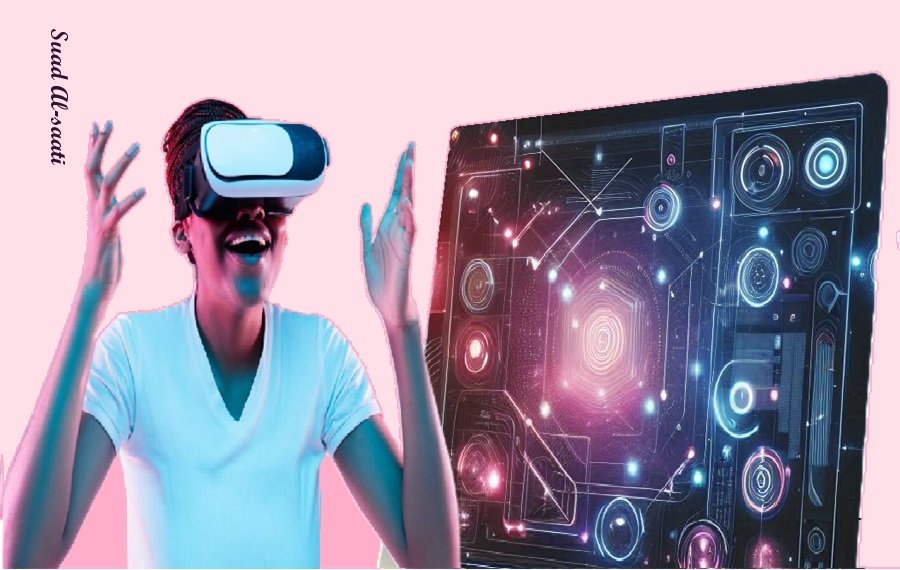
Digital development has reached a point where digital tools can understand human thought and provide useful tools.
They are excellent companions and valuable partners in serving those interested.
Digital tools enhance creativity and determination.
They are applications and systems designed to break down intellectual barriers and build innovative ideas, helping to transform those inspiring ideas into effective and sustainable projects.
This is achieved through the creation of visually creative mind maps, such as the innovative brainstorming tool.
Ideas are organized and planned as a visual representation of symbols that can be shared and applied.
Examples of such tools include:
Miro, which provides an unlimited workspace for brainstorming.
Similarly, Mindmeister is a unique tool for creating interactive mind maps that expands thinking and problem-solving horizons by breaking down tasks according to their size and priority.
Organizing ideas requires continuous and sustainable development to acquire lasting productivity methods.
Organized ideas evolve through their production, supported by the foundation they provide for a successful business strategy.
Project Management and Collaboration Tools and Digital tools make collaboration smoother.
In conclusion: When technology becomes an integral part of an artistic identity, digital tools are no longer mere tools.
They are part of the journey of genuine creativity and determination, its evolution, style, and unique signature.
This becomes even more apparent when supported by the right tools
Ultimately, technology empowers us to transform ideas into reality and visions into finished products
The importance of logical thinking lies in the mental skill to solve a particular problem, make a sound decision about it, and separate emotions from facts in order to reach a solution.
This opens up a wide field of understanding, through comprehending the connections between cause and effect
Ultimately, this leads to success in professional and academic life, as well as effective interaction with our surroundings.
However, Jan laid down rules for new ideas, studied them, and turned them into a real and organized framework for action, rather than just a passing thought
The innovator can logically generate ideas to solve the problem through analysis, deduction, planning, and organization
In addition, the ideas are subject to clear and rational steps, which provides a framework that helps him to grow systematically.
Moreover, logic is the bridge that transforms flashes of ideas into viable projects, and turns vision into reality.
Developing creativity: In line with meeting the urgent need for it and searching for fertile ground for creativity,
innovative ideas emerge freely, taking on deeper dimensions and diverse forms, to produce a wonderful and unique work.
Human needs are not limited to a specific stage, but continue with development and events.
Minds then become preoccupied with finding solutions,
and this is where the stage of expanding latent capabilities begins, revealing skills we were previously unaware of.
Reflection and intellectual review represent a transition to a deeper level of awareness, going beyond the need for support and appreciation.
Given the importance of logical thinking in creativity, it forms a solid foundation for growth and progress.
It involves integrating discipline and analysis to establish a firm basis for new ideas, transforming them into a real and organized framework, rather than just fleeting thoughts.
Innovators can generate logical ideas to solve problems through analysis, deduction, planning, and organization
When we subject ideas to clear and rational steps, we don’t stifle creativity; instead, we provide it with a framework that helps it grow systematically.
Logic here is not the enemy of imagination, but rather the bridge that transforms flashes of ideas into viable projects, enabling the innovator to turn their vision into a tangible reality.
Fostering Creativity: In line with the pressing need for creativity and the search for a fertile environment for it,
innovative ideas emerge freely, taking on deeper dimensions and diverse forms, to produce remarkable and unique work.
Human needs are not limited to a specific age group;
rather, they constantly evolve and adapt, becoming a tangible reality that contributes to most practical and essential aspects of life and all stages of education,
as well as secondary aspects that are considered luxuries, inspiring hope for greater creativity.
Thus, the mind is engaged in finding solutions
This is where the stage of developing latent abilities begins, revealing skills we were previously unaware of.
Therefore, the importance of reflection and intellectual review becomes clear, leading to the discovery of more innovative ideas.
Moreover, through continuous development and adaptation, this becomes a tangible reality that contributes to most aspects of life.

The essence of inspiration is a force that flows with thoughts and transforms into a clear vision.
Inspiration, felt in all fields, reflects the depth of its creators.
Inspiration is not bound by rules, laws, or theories. Rather, it is the moment of feeling it, the moment when mind and spirit merge with utmost sincerity, becoming one with the idea, searching for solutions to a problem or an answer to a perplexing question.
As a result, an innovation emerges from brainstorming—a mature idea that skillfully offers solutions to shortcomings, granting its creators a unique and exceptional identity.

Let me think; I am immersed in my thoughts, my mind is engaged, but it neither works nor speaks, not even with a single movement, because it is oblivious to its surroundings.
If something were to fall, its sound would go unheard because it is absorbed in itself, in a purely internal interaction, searching for what it truly feels, not for what is said or what is theoretically understood.
Lesson: Inspiration transforms a simple experience into a timeless masterpiece
A small company faced a crisis in completing a project due to a lack of resources.
However, the manager did not give up.
Inspired by a previous experience in volunteer work, where interaction generates an automatic sense of cooperation without expecting anything in return,
his passion lay in the work itself.
He devised an “internal exchange” system between teams: each team helped the other teams with a part of the project.
Result: The project was completed on time, and the crisis turned into an opportunity to strengthen the bonds between the employees.
Thus, inspiration offers opportunities to find unconventional solutions in times of crisis.


A young painter tried repeatedly to paint a landscape, but he was never satisfied.
One day, while sitting by a small window in his village, he saw the sun’s reflection on a pond. That moment inspired him to paint the scene as he felt it, not as he saw it.
Thus, the painting became a symbol of inner truth and was later sold at an international exhibition.
Lesson: Inspiration transforms a simple experience into a timeless masterpiece.
A math teacher noticed that her students were bored with dry equations.
But during a school trip, she watched them compete in a numbers game on the bus.
As a result, she was inspired to transform lessons into quizzes and games. Suddenly, the students’ grades improved, and they eagerly awaited each lesson.
In fact, inspiration transforms boredom into passion and makes learning an enjoyable experience.
Read more about the impact of inspiration in general.

A Source of Inspiration
Inspiration is the sudden spark of creativity and the state of mental stimulation that ignites the birth of ideas.
Inspiration arises from a person’s interaction with their surroundings and their inner world. This inner world is teeming with events; in other words, inspiration cannot be bought or sold; it is the place where ideas are born spontaneously.
Rather, it comes according to the influences that time has etched within, transforming them into stories that cannot be narrated but only experienced internally. These stories can only be revealed through similar events, such as joys and sorrows.
Furthermore, life holds secrets, and its most beautiful secret lies in nature’s beauty. This beauty generates a sense of psychological comfort, open to receiving illuminating inspiration, which in turn stimulates tranquility to create something innovative. Thus, the source is nature and its pure, spontaneous beauty, free from pretense, affectation, or artifice.
And more… Learning can inspire some, increasing their passion for what they’ve learned and deepening their understanding. This leads to a stronger conviction that all the knowledge they’ve acquired can be repurposed with a fresh perspective, as if they’ve opened a window to see the light from another direction.
Inspiration resides within the soul; it requires no effort, only listening to one’s inner voice.
The more spontaneous, sincere, dedicated, and passionate a person is about accomplishing a task, the more they open their heart to it and approach it with seriousness and sincerity.
Furthermore, when faced with a complex situation demanding innovative solutions, the need arises for a mental strategy that generates solutions through brainstorming.
Therefore, these innovative solutions involve gathering similarities between accumulated and stored information from similar events.
From this, unconventional solutions emerge from the depths of thought, culminating in a highly suitable solution.
Inspiration is of paramount importance in life, adding something that cannot be found in reality. It bestows a sense of inner peace, like an invitation to a spiritual dialogue. It requires no effort, only certainty—a moment of receiving a divine message carrying a profound idea, accompanied by a detailed outline of the concept. All one has to do is accept it and apply it with an open heart.
In any case, inspiration does not come through willpower or skill, but through purely spiritual moments, like a flash of light that awakens insight in the heart.

Part Two – The Intellectual Development
Human Intellectual Development and How Intelligence Grows with Human Growth
Human intelligence typically develops through experiences and knowledge acquired through training or education. While it is innate, it continuously matures and evolves through discovery and exploration.
Furthermore, through interaction with the surrounding environment, these interactions intertwine with experiences and mental insights, stimulating new, Technologically advanced ideas
As a result, brainstorming solutions are linked to daily life, leading to easier, more effective, and faster-to-implement technological solutions.
In addition, this reduces the time and mental and physical effort required to address problems.
This, in turn, simplifies approaches and generates innovative ideas and insights for dealing with new developments.
Moreover, this approach fosters a work environment characterized by creative thinking in the field of modern technology, as it requires a deep understanding of the surrounding environment.
Thus, this is how nations are built: from human development to intellectual and mental development, ultimately leading to progress.
Consequently, backwardness leads to regression in all areas, including the overall economy, which relies entirely on the workforce for production without intellectual development.
Therefore, intellectual development is essential to enable individuals to engage in productive work in all vital sectors to achieve prosperity.
Thus, the skills of the workforce are aligned with its intellectual capacity for production. This is the experience gained through understanding one’s mental and physical actions with greater logic and wisdom.
Introduction: Creative ideas and solutions are a cornerstone of human progress in productive and service innovations. They stem from the real needs of societies and aim to provide creative and practical solutions to the challenges that affect daily life
By combining imagination and problem-solving, innovation transforms ideas into tangible results that improve living standards, strengthen economies, and inspire future generations.
Creative ideas and solutions. often stem from the basic needs of communities. When people face challenges, whether in housing, agriculture, or education, they begin searching for solutions. These solutions are not arbitrary but are built upon accumulated knowledge, observation, and creativity. Innovation flourishes when individuals and groups carefully study their environment and identify opportunities for improvement.
Nature, the wellspring of creative ideas and solutions, is one of the oldest and most sustainable sources of innovation. Humanity has long drawn inspiration from nature, devising ways to extract products, harness energy, and develop sustainable practices. From agricultural technologies to renewable energy, nature continues to provide models for innovative solutions. For example, land reclamation through precision tillage and irrigation demonstrates how natural resources can be transformed into productive assets.
Housing and Urban Development
In densely populated areas, innovative creative ideas and solutions focus on building residential complexes that optimize space utilization while ensuring comfort and sustainability. Smart housing solutions integrate eco-friendly designs, energy efficiency, and shared spaces to enhance quality of life.
: Agriculture and Land Reclamation
Land reclamation projects are vital to food security. By implementing advanced irrigation systems and soil management techniques, communities can transform barren land into fertile fields. The benefits of these projects extend beyond food security; they also contribute to job creation and stimulate local economies
: Education and Scientific Advancement
Educational programs designed to foster scientific advancement represent another form of innovation. By integrating technology into classrooms, supporting scientific research, and encouraging creativity, communities prepare future generations to tackle complex challenges
: Infrastructure Development
The projects encompass creative ideas and solutions, as well as large-scale infrastructure projects such as bridges, subway tunnels, and transportation systems. These projects arise from the need to connect communities, alleviate congestion, and support economic growth. Each project represents a solution to a specific challenge, achieved through engineering ingenuity and meticulous planning.
Therefore, studying and understanding the surrounding environment inspires individuals and organized groups to expand the scope of their development projects. Innovation is not limited to individual efforts; it often requires broadening the scope of shared environmental ideas and solutions, and fostering cooperation between governments, the private sector, and local communities. This collective approach ensures the sustainability of projects and their benefit to society as a whole, enabling the country to achieve a high level of self-sufficiency, investment, and economic growth in line with the demands of urban expansion and ongoing development.
Therefore, most societies embrace the idea of ​​finding solutions that support targeted projects and provide tangible services. Innovative projects contribute directly to national progress by creating jobs, improving infrastructure, and boosting productivity. They also strengthen the economy by creating new industries and expanding existing ones
Ultimately, innovative projects not only solve immediate problems but also pave the way for sustainable development, ensuring that future generations inherit systems and structures that continue to serve them. Whether through renewable energy, smart cities, or advanced education, innovation remains the key to long-term prosperity.
Conclusion, creative ideas and solutions naturally give rise to innovation, which is the bridge connecting challenges and solutions. From housing and agriculture to education and infrastructure, innovative projects transform ideas into tangible realities. They embody creativity, precision, and collaboration, propelling societies toward progress and sustainability. By embracing innovation, societies not only address current challenges but also lay the foundation for a brighter future
Facts have proven a close link between the psychology of creativity and true determination.
True creativity is a complex psychological process that requires persistent willpower.
It begins with rejecting stereotypical ideas and transcending familiar boundaries, passing through the throes of doubt
and experimentation to achieve genuine accomplishment.
This is driven by a determination that protects passion
from dissipation and deviation from the principle shaped by the mind’s strategy,
while preserving the psychological foundations of creativity through the flexibility one has
adopted and adapting to every change that occurs during the process.
How is this adaptation achieved despite the persistence and determination to pursue the goal?
It is achieved by seizing opportunities when unexpected errors or mistakes occur. One uses
these opportunities as starting points, not ending points.
Determination is the internal fuel and motivator for research,
discovery, and identifying strengths and weaknesses that cause errors, rather than waiting for external encouragement from managers or colleagues.
In psychology, true creativity and determination are the combination of passion, diligence, and sustained, long-term effort.
The strategy of linking creativity and determination is manifested through mindfulness,
which the mind uses to gather and connect ideas through reflection.
This leads to a state of mental tranquility and a flexible space
that alleviates accumulated pressures, allowing for the generation of new ideas as alternatives,
which are then stored.
As a result, the creative individual clearly sees the root of the problem,
developing a genuine vision and the ability to analyze the equation, enabling them to make a firm and decisive decision.
This distinctive characteristic makes the determined creative mindset adopt
this strategy as an inherent mental approach in its work and behavior,
as psychologists have meticulously documented.eas as alternatives, which are then placed on reserve.
Within this broad framework, the psychology of creativity and determination functions as an intelligent analytical approach.
It reads ingrained behaviors,
interprets the underlying signals in the actions of the creative individual,
and reveals their unwavering determination to achieve success skillfully and confidently, delving into the depths of the psyche.
It also establishes the links between creativity and determination as a reality emanating from within the mind,
and the ability to achieve successful results with high skill.
Defining the General Concept, is a profound internal process in which an idea or motivation is implanted in the heart or mind
It is not merely a fleeting feeling, but a cognitive and spiritual force that stimulates innovation and change
This convergence provides new energy, a different perspective, and the motivation to overcome obstacles and achieve goals
It is a cognitive and spiritual force that stimulates innovation and change
The word “inspiration” is derived from the root “to inspire,” which means something implanted in the soul and received directly by the heart
However, depending on an individual’s intentions, positive inspiration refers to what guides them toward goodness and creativity
The opposite is also true
It has no specific time, place, or instrument. It is spontaneous, arising suddenly as an idea or internal motivation
As a result, it provides positive energy that propels a person to face difficulties
Therefore, inspiration, whether it is an inspiring person who influences others or an idea that motivates an entire team
its importance lies in its ability to generate new ideas and unconventional solutions. Moreover, it fosters perseverance and the ability to find alternatives in the face of crises
This leads to personal growth: it boosts morale and increases productivity
As is the case with scientists and thinkers who have made their experiences a source of inspiration for generations
Note: There is a difference between inspiration and temptation
True inspiration: This is what God plants in the heart or stems from genuine experience, and it calls towards good
Temptation: This is what Satan plants or the whispers of the ego, and it calls towards falsehood and delusion
Inspiration is like a deep breath
Moreover, it is a single breath that nourishes the soul with life and awakens in it a tranquility that did not exist before
From this breath spring vibrant, passionate, and deeply tangible discoveries
As a result, creative and innovative energy flows
And a harmony that inspires profound and innovative creativity and propels achievement
A philosophical concept of inspiration, the word is derived from the root of the verb “to devour” or “to swallow,” meaning to absorb an idea, digest it, and extract its essence, much like a metabolic byproduct is extracted to compensate for a hormone deficiency
Naturally, this dynamic process of processing is how inspiration interacts with problem-solving. As a result, professionals excel when a positive spirit permeates the human psyche, prompting it to interact with the mind to generate a mental concept derived from the source of the problem, ultimately leading to the optimal solution
the impact of inspiration. Practical examples from various fields illustrate how inspiration works in everyday life and how it transforms from an internal thought into a tangible effect
👍 In art
👍 In management
👍 In education
•— Inspiration
Inspiration: The language of light and inner pulse. It is the moment when the soul gently leans towards its Creator, opening a hidden passage within
A warm current flows inward, filling every quiet corner with radiant breath
Thoughts erupt like glowing sparks, multiplying in the stillness of the mind
From this eruption springs a creation shaped by emotions, bearing the imprint of the heart
Inspiration is a ray of light that penetrates the mind and heart, revealing what was hidden in the shadows
Its threads gently gather, weaving themselves into a single, luminous achievement that reflects the vision of the soul and the truth of its moment of birth
: Inspiration
Inspiration springs when the soul enters a state of harmony with its Creator, allowing an inner current to permeate the self without resistance
This current becomes a reservoir of vital, nourishing breath, awakening the latent structures of the mind
Thoughts begin to flow, not as random impulses, but as an organic creation in harmony with the present moment
What emerges is a unique manifestation of inner awareness, translated into a tangible form where every detail reflects a pre-existing intention
Inspiration acts as a penetrating light, piercing the mind and heart, revealing what was hidden
Its threads intertwine to form a unified whole, an achievement that embodies the individual’s spiritual realization and the existential circumstances surrounding that moment
•— Inspiration
Inspiration can be understood as a spiritual and psychological state in which the individual experiences a profound connection with a transcendent source.
This state generates an internal flow of cognitive and emotional energy,
activating previously inaccessible mental pathways. As a result, ideas increase in number and complexity, ultimately forming an innovative concept that resonates with the demands of the current context.
The result is a tangible expression of inner experience, formulated with remarkable clarity and precision.
Thus, inspiration acts as an illuminating force, revealing latent cognitive content, and enabling these elements to merge into a unified creative output that reflects the individual’s inner world and the circumstances surrounding them at the time of creation.
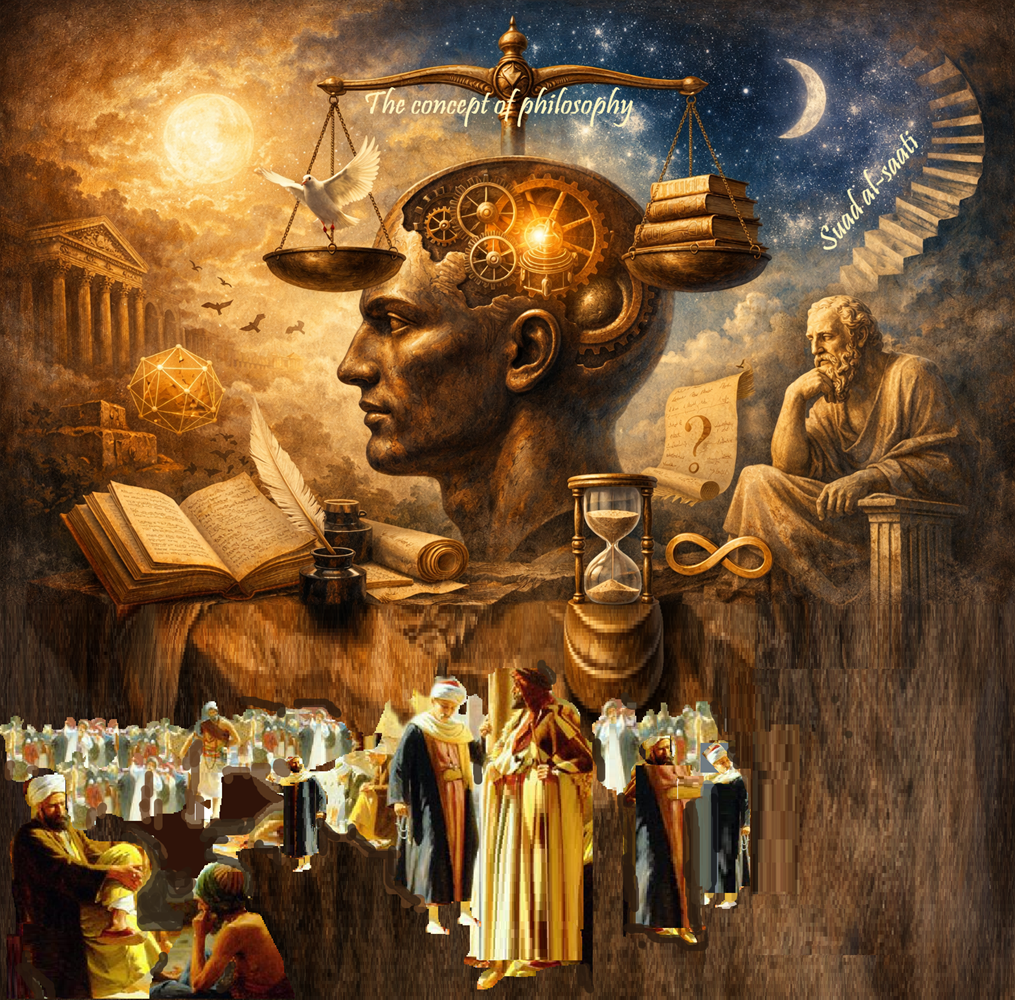
First and foremost, philosophy, in its essence, is a relentless search for truth. It does not settle for superficial answers, but rather seeks to delve into the depths of the great questions: What is the meaning of life? What is good? How can justice be achieved? These questions are endless, but they are renewed with every era, making philosophy an ongoing dialogue between the past, present, and future.
Indeed, one of the most important functions of philosophy is that it empowers individuals with the ability to think critically. It encourages questioning established beliefs, re-examining prevailing ideas, and evaluating them logically. This critical thinking is what distinguishes advanced societies, because it fosters innovation and prevents intellectual stagnation.
addition, freedom is a fundamental element of philosophy. It grants individuals the power of choice and makes them responsible for their decisions. Philosophy views freedom not merely as a right, but as a conscious practice that requires a balance between the individual and society. In this sense, philosophy becomes a tool for cultivating intellectual independence and moral commitment.
Moreover, justice is a central concept in philosophy from Plato to contemporary philosophers. They are not just laws, but a higher human value that seeks to achieve equality and fairness.
In addition, philosophy helps to understand justice as a balance between rights and duties, and between individual freedom and the public interest.
Furthermore, philosophy is also linked to time. It studies the past to understand the present and looks to the future to guide humanity toward a better life. Symbols like the hourglass or the infinity symbol reflect this temporal dimension, where philosophical thought becomes an endless journey through the ages.
As a result, dialogue is the heart of philosophy. Since the Socratic dialogues, discussion has been a means of arriving at truth. Philosophy is not built on isolation, but on the exchange of ideas between individuals and groups. This dialogue creates a more conscious society and promotes the values ??of tolerance and understanding.
Clearly, although philosophy may seem theoretical, it is deeply connected to everyday life. It helps people make decisions, understand themselves, and cope with challenges. Philosophy is not an intellectual luxury, but a practical tool for guiding behavior and achieving psychological and spiritual balance.
The concept of philosophy transcends traditional definitions to become a comprehensive worldview. It is a search for truth, a practice of freedom, a call for justice, and an ongoing dialogue across time. Philosophy empowers individuals with critical thinking skills and helps them face life’s challenges with awareness and responsibility. Ultimately, philosophy is not merely an idea to be articulated, but a way of life to be practiced, illuminating the mind and balancing knowledge and peace, the individual and society, and the past and the future

Some of us humans are made of raw material (free clay), but through friction and ordinary human needs, monsters emerge beneath the human mask, darkening and staining the raw material with dust. But this will not last long, and the raw material will return to its pristine state. From this raw material, the contemporary myth is born
A myth is not an escape from truth; it is another way of telling it. Truth, when spoken directly, becomes narrow-confined by names, trapped in detail, reduced to specific people and places. But when truth becomes a myth, it frees itself from all of that.
So, when a writer changes cities, replaces faces, or hides names, they are not avoiding reality. They are expanding it. They are giving the event a life larger than its moment, a meaning that outlives those who caused it
We do not write to decorate a page or to present a polished narrative.
We write because something is moving inside; and therefore, what moves inside must come out – not by chance, but rather as a natural result of a long and invisible internal interaction
This is why I do not erase what I write. Because the text is not an attempt; it is a testimony. Not an idea, but a trace. Not a composition, but a pulse.
Those pages we buy at great expense to share real experiences for future generations to learn from – yet ironically, these same pages conceal behind them all the traces of the very corruption we wish to warn future generations against. In other words, the medium betrays the message.
We will not be shocked by such things, for indeed, we do not come from a vacuum and write articles; instead, we come from firsthand experience of what goes on behind the scenes and its destructive arts, shattering the hopes of humanity.
The journey did not begin with a word, but with the shock of the first page.
A fragile page that could not bear the pressure of a pen, nor reflect the sun’s light—as if, from the very beginning, it was created to be erased before it could ever be written on. Thus, when the pen fails to write, the failure is not in the pen, but in the page that does not know how to receive truth.
So, the pens are set aside, the axes are raised, and the writing moves to the asphalt.
Asphalt does not pretend to be strong; it simply holds the mark.
In the sea of hungry whales, words are swallowed before they are spoken, and meanings are erased before they are born. Yet, when the pen is cornered, it has only two choices: to write… or else let the asphalt write on its behalf.
we know they watch every movement on the canvas before it reaches the open air. But what rises from within cannot be silenced or contained, because it comes from a place they cannot reach.
The raw material shaped by days does not break. It changes form, yes-but its core remains untouched.
And this is how the contemporary myth is created: from a trace that cannot be erased, from a truth that cannot be spoken directly, and ultimately, from a writing that does not fear being seen.
For centuries, intelligence was treated as a fixed, almost mythical quality-something inherited, measured, and judged through narrow academic lenses. A child who excelled in mathematics or language was labeled “intelligent,†while others were quietly pushed aside, as if human potential could be reduced to a single dimension
But intelligence, in its essence, was never a number. It was never a grade. It was never a competition
Yet somewhere along the way, the concept of intelligence became distorted, misused, and even weaponized-
Historically, intelligence was defined by
Logical reasoning♾ï¸
Linguistic ability♾ï¸
Mathematical performance♾ï¸
Educational systems relied heavily on these measures. Students were trained to
Solve equations♾ï¸
Extract roots♾ï¸
Work with decimals♾ï¸
Memorize rules and algorithms♾ï¸
These skills later formed the basis of statistical programming and data-driven tasks. But the model itself was rigid, assuming that all learners think, learn, and succeed in the same way
: This was the first myth
That intelligence is a single thing, measured in a single way, and expressed through a single path
We see the misuse of intelligence everywhere
People who use their skills for manipulation rather than creation
Institutions that prioritize profit over purpose
Systems that reward shortcuts instead of understanding
Individuals who treat intelligence as a weapon rather than a responsibility
This is not intelligence
: This is cleverness without wisdom
True intelligence appears in quieter places
In the person who solves a problem without harming others-
In the learner who adapts despite obstacles♾ï¸
In the creator who builds something meaningful♾ï¸
In the thinker who uses knowledge ethically♾ï¸
Intelligence is not what we know♾ï¸
It is how we use what we know
Artificial intelligence can
Process massive data♾ï¸
Learn patterns♾ï¸
Predict outcomes♾ï¸
Automate tasks♾ï¸
: But it cannot
Understand morality♾ï¸
Feel empathy♾ï¸
Choose integrity♾ï¸
Carry responsibility♾ï¸
Human intelligence carries ethical weight
AI carries computational power
The danger is not AI itself, but the human misuse of intelligence-whether natural or artificial
: In recent years, intelligence has been used
For hostility♾ï¸
For revenge♾ï¸
For manipulation♾ï¸
For illegitimate gain♾ï¸
This contradicts the very essence of intelligence
Because intelligence without ethics becomes destruction
Intelligence without understanding becomes chaos
Intelligence without purpose becomes noise
Understanding must come first
Then mental activity♾ï¸
Then organization♾ï¸
Then action♾ï¸
This is the natural order of true intelligence
Intelligence is not a weapon♾ï¸
It is not a tool for superiority♾ï¸
It is not a shortcut to power♾ï¸
It is a responsibility-to ourselves, to others, and to the world we shape
The myth of intelligence collapses the moment we recognize that
Intelligence is diverse♾ï¸
Intelligence is ethical♾ï¸
Intelligence is purposeful♾ï¸
Intelligence is human♾ï¸
And the greatest intelligence is not in knowing more
but in using what we know wisely

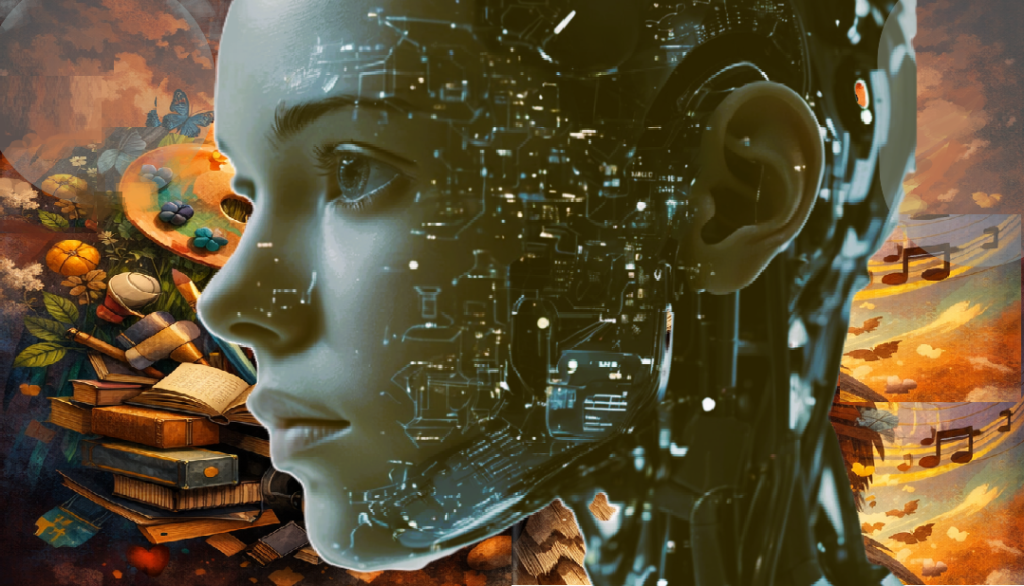
The image above captures the silent tension between human cognition and artificial systems-a tension that has shaped our understanding of intelligence for decades. As technology evolves, the boundaries between natural and manufactured intelligence blur, forcing us to rethink what it truly means to understand, to analyze, and to create. This article explores that transformation, and the myths that have shaped it.
Creative abilities, or the capacity for profound innovation, crystallize when diverse skills combine to form harmonious ideas, blending intellectual, psychological, and technical dimensions with a sophisticated, innate artistic style.
This capacity is cultivated through sustained effort, adherence to art, values, and principles, and a constant striving to transcend and break free from the conventional.
The result is a visionary innovation, emanating from the depths of the individual and expressed through symbols that reveal a profound and boundless perspective.
This innovation is characterized by unique logical precision and exceptional clarity of vision.
Digital sovereignty is the right of an individual to control their digital presence, tools, and data without external dependence. It emphasizes autonomy, resilience, and the ability to protect their identity in a connected world. By asserting sovereignty, individuals and communities maintain their independence while shaping their digital future with clarity and responsibility.
Independent archiving is the practice of preserving knowledge, documents, and creative works outside of centralized systems. It ensures continuity, authenticity, and intergenerational accessibility. By maintaining archives independently, individuals protect cultural memory and intellectual heritage from loss, manipulation, or erasure, fostering trust and long-term resilience.
Educational legacy refers to the transmission of knowledge, values, and intellectual contributions across time. It is built through teaching, documentation, and guidance, ensuring that wisdom remains available to future learners. This legacy strengthens cultural identity and empowers communities by connecting past insights with evolving educational needs.
Creative documentation blends artistic expression with the systematic recording of ideas, projects, and experiences. It transforms ordinary records into meaningful narratives, preserving factual details and creative depth. Through this practice, documentation becomes not merely a technical process, but a creative act that enriches memory and inspires future innovation.
The Ethical Web is a vision for digital spaces guided by fairness, transparency, and respect for human dignity. It challenges exploitative practices and promotes responsible design, privacy, and inclusivity. By integrating ethics into online interactions, the web becomes a place of trust, empowerment, and shared responsibility for collective well-being.
A personal archive is a curated collection of an individual’s digital and physical records—letters, writings, photographs, and projects. It reflects identity, memory, and creative journey, providing continuity across life’s stages. By organizing and protecting personal archives, individuals preserve their authenticity and ensure their voice remains accessible to future generations.
Digital rights are fundamental freedoms in cyberspace, including privacy, access, and expression. They protect individuals from data misuse and ensure equitable participation in the digital society. Supporting these rights promotes autonomy, builds trust, and ensures that technology serves humanity rather than undermines it.
Creative thinking and genuine Resolve, represent an indispensable transformative approach in today’s era of innovation.
This approach has become a critical global strategy,
a mindset and behavioral framework that prioritizes solutions as a subject of study and professional training,
and is adopted by organizations to address complex challenges in innovative ways.
By placing the user at the heart of the process, this methodology encourages empathy, experimentation, and repeated problem-solving.
As a result, it produces solutions that transcend traditional frameworks, leading to distinctive products, services, and business models.
Furthermore, creative thinking coupled with determination is a crucial aspect of demonstrating organizational loyalty
and competitiveness, enabling collaborators to generate more innovative ideas, explore new opportunities, and achieve sustainable growth.
Understanding “creativity” and “genuine determination” requires examining the core project objective and seeking logical solutions that serve the user and add real value.
Therefore, traditional approaches that rely on linear and repetitive problem-solving have become outdated, slow, and prone to recurring errors.
In contrast, creative thinking and “genuine determination” involve exploration, iteration, and innovation, transcending traditional frameworks to achieve innovative, efficient, responsive,
and error-free results.
Thus, the incentive to foster expanded intellectual capabilities through collaboration and constructive competition demonstrates dedication and loyalty in the workplace.
In fact, empathy:
The first step is empathy—understanding the user’s needs and challenges.
Creative thinking and true determination involve engaging with communities, conducting interviews, and observing behaviors to identify weaknesses.
This stage ensures that solutions are based on real human experiences rather than assumptions.
Furthermore, simply gathering information is not enough; the problem must be clearly defined.
A well-crafted problem statement guides the creative thinking
and true determination process and ensures that the team addresses the right problem.
A precise definition also prevents wasted effort and keeps the project focused on realizing the value of creative thinking and true determination.
Clearly, creative thinking and true determination, idea generation: During the idea generation phase, brainstorming sessions produce numerous ideas.
Creativity flows freely, and no idea is dismissed prematurely.
The goal is to explore diverse possibilities before narrowing them down into promising solutions.
This is where skilled innovators shine—they are able to quickly identify key points and transform abstract ideas into actionable concepts.
Prototyping: Building prototypes involves creating models or drafts of potential solutions.
These prototypes enable creative thinking and hard work, allowing for the conceptualization and practical testing of ideas.
They don’t need to be perfect; rather, they serve as tools for learning and development.
Addition and Testing: Testing is the final step, where prototypes are evaluated with actual users.
Feedback is gathered, adjustments are made, and solutions are improved.
This iterative process ensures that the final product is not only functional but also meets user needs.
In fact, the creative and determined individual is characterized by precision and quick wit, seamlessly integrating elements to ensure the final product shines with innovation.
Their ability to balance innovation with practicality makes their work impactful and unique.
Unlike others who might rely solely on technical skills, the resolute innovator employs vision and imagination to deliver solutions of genuine value.
The Importance of Creative thinking and True Resolve in Business
As a result,Creative thinking and True Resolve, is no longer confined to design studios;
it has become a strategic tool for companies worldwide.
Businesses use it to innovate, enhance customer experiences, and maintain their competitive edge.
By adopting a user-centric approach, organizations can uncover hidden opportunities and create differentiated products in crowded markets
In conclusion, Creative thinking and True Resolve, is much more than a structured methodology;
it’s a mindset that fosters creativity,
cultivates empathy, and transforms problem-solving into a human-centered journey.
By accelerating business development, improving products and services, and unlocking innovative prototyping,
Creative thinking and True Resolve, provides a framework that bridges the gap between imagination and practical implementation.
Ultimately, creative thinking and genuine design enable both departments and their employees to deliver a pattern that can be used by everyone through education and training, and to transform it into tangible realities that serve the work environment, enhance competitiveness, and achieve sustainable success.
As a result, Creative thinking and True Resolve are two fundamental pillars of innovation in today’s world.
The Philosophy of Experience
This space represents a platform for studying the impact of experience on developing understanding. Knowledge is not built on the absence of error, but rather on analyzing its results and transforming them into an applicable intellectual framework. Every incomplete step is treated as part of the learning process, not as a burden to be hidden.
The Growth Approach
Goals are not deferred dreams, but rather organizational tools that redirect effort toward what is possible. Success is measured by the consistency between understanding and practice, not by external recognition. Wisdom, on the other hand, is the product of accumulating experiences and reformulating them into transferable insights.
Sharing Knowledge
Transferring experience is not an emotional act, but a cognitive responsibility. When paths are clearly presented, past mistakes become new roadmaps, and shared knowledge becomes the foundation for more precise and conscious progress.
Welcome to Souad Al-Saati’s website
A space dedicated to transforming experience into knowledge and cultivating a more mature and profound digital understanding

First and foremost, the spark of cumulative creativity stems from the goal itself
Developing cumulative creativity, or creative momentum, leads to a continuous generation of new ideas.
When a project focuses on a specific point
it stimulates the emergence of other ideas, ensuring the project’s continued development and growth in the field of innovation.
In fact, creativity, discoveries, and inventions stem from the project’s perspective and objective,
through collaborative thinking integrated with the surrounding creative work environment.
The cumulative aspects of this environment, which are both influenced by and influence these aspects, include
A reciprocal influence encompassing accumulation with growth, creative movement, continuity of work, momentum generation phases,
and factors that foster synergy and curiosity, leading to the creation of new and innovative ideas
Creative momentum is formed through its role in connecting reality with imagination to produce unconventional creative outputs,
resulting in a continuous flow of new and innovative ideas. Since strategy determines its course, the moment of interaction between these two paths is crucial: momentum begins at their convergence
The path (the core idea) operates along a regular and stable central axis. This path (the elements that revolve around it) moves at a flexible speed, adapting to change and expansion.
This interaction is similar to the moment an engine starts. Therefore, motion alone is insufficient; momentum requires a close connection between the elements.
But motion alone is also insufficient; momentum requires harmony among
the elements involved, from the initial stages of the process to the final result
(المزيد…)Introduction: We would like to point out some things in our plan that is currently being implemented. Awareness Before Skill
In a world where intellectual deviations are accelerating and the compass is lost amidst noise and truth; awareness becomes a prerequisite before any practical step
A person who doesn’t understand logic and doesn’t know its limits and the limits of others, cannot progress, regardless of their skills or qualifications
This text is not a philosophy lesson, but rather a guiding window to set the reader on the right path before entering any professional or training field
📌 Logic… The First Gateway to Progress
Logic is not a rigid subject, but a way of life
: It is the ability to
See the truth without distortion
Understand causes before effects
Distinguish between what is said and what is intended
Protect oneself from deception
Make informed decisions
Without this foundation, a person becomes a follower of intellectual deviations instead of a leader of their own path
📌 Why Do Some People Go Astray
Because they
Confuse emotion with reality
Follow the noise instead of understanding
Think skill alone is enough
Run away from self-confrontation
Refuse to acknowledge limitations
And these people-no matter how much they learn-remain trapped in a cycle of chaos
📌 Awareness before training: A prerequisite for entering any project
Before anyone learns:
Business management
The art of tailoring and sewing
Partnership in sports
Or any profession that generates income legitimately
: They must understand
The meaning of commitment
The meaning of responsibility
The meaning of boundaries
The meaning of refined conduct
The meaning of respecting time and effort
Because skill without awareness equals chaos.
And awareness without skill equals inadequacy
But combining them equals true strength.
📌 The Experienced Stage… The Area Where Everyone Gets Lost
This stage-as you described it-is the gray area where One doesn’t know where to begin
Or where to go
Or how to evaluate oneself
Or how to deal with others
: This is where this article comes in
To clarify the confusion, rearrange concepts, and open the door for those who genuinely want to learn
📌 Boundaries of Engagement… Before any training begins Anyone, who wants to join your projects must know Because we don’t work with those who lack discipline
Or with those who confuse seriousness with frivolity
Or with those who shirk responsibility
Or with those who refuse to develop themselves
We work with those who understand logic
Those who respect time
Those who know the value of effort
Those who want genuine progress
This will be their first test.
📌 Towards a Comprehensive Project… A Vision That Goes Beyond This Article
This article is not an end, but a beginning
: Each paragraph here can be transformed into
An independent article
An awareness lesson
An explanatory video
A training plan
Or a complete professional project
With our expertise in management, detailing, sports, and guidance, we have the ability to turn this vision into reality
Conclusion: The Beginning
Welcome to this digital corner, where there is no room for boasting or fear of criticism
: Here, there is only
A space to breathe and achieve for those who haven’t been able to achieve it
A window of light for those who have been deliberately targeted by obstacles
And a quiet voice saying: We are here… just as we are
Note about the site: The goal is to study the street, what is going on in people’s minds, and the extent of individual differences in understanding, knowledge, and culture. Our idea of ​​a blog site is the starting point we need for this study, followed by our websites for selected projects. These projects were chosen after studying and analyzing the locations and the desires of job applicants for the proposed projects. We also open the door to real participation with direct human responses for each participant’s opinion… What began here… will be completed there, where the idea reaches those who deserve it. And we place our trust in God.

Creativity is not a fleeting spark-it is a disciplined force that transforms imagination into reality. The true power of creative abilities lies in their capacity to break boundaries, to reframe challenges as opportunities, and to weave originality into the fabric of everyday life. It is through creativity that ideas gain momentum, solutions emerge from complexity, and human potential finds its fullest expression
In a world saturated with repetition and noise, authentic creativity becomes a rare voice of clarity. It is both resilience and vision: the courage to innovate when convention resists, and the determination to shape meaning where others see only obstacles. To embrace creative abilities is to embrace the art of renewal—an endless pursuit of excellence that enriches not only the individual but the collective experience of society
The essence of creativity lies in the power that arises when two creative impulses interact simultaneously: a static impulse that forms the core, and a dynamic impulse that revolves around it, complements it, and transforms it from an idea into a complete system
This interaction between the static and the dynamic is what creates the creative momentum that produces the world’s greatest achievements
An idea begins small and simple, a mere point
But when it enters the cycle of interaction between two impulses—one laying the foundation, the other providing the impetus-it grows into a vast system that stretches from the earth to the sky, from simple tools to airplanes and spacecraft
Everything around us—from the house we live in, to the furniture we use, to the car we drive—is the product of a creative accumulation involving dozens or even hundreds of minds.
Every component, no matter how small, is the fruit of an idea, a skill, experience, and innovation
But people usually only see the “final product” and overlook the creators who laid the foundations, without whom nothing would exist
The concept of collective creativity is not based on a single line or a single idea, but rather on the harmonious assembly of small and large, static and dynamic elements that integrate sequentially or in succession to produce efficient movement around a central core
It’s like a truck moving with immense mass, yet relying on coordinated parts, some static and some dynamic, each part representing an innovation in itself.
This applies even to the most complex industries: a nuclear reactor, for example, is not a single device, but a system of thousands of materials, elements, and designs that have been integrated, disassembled, reshaped, and developed through long stages until they reached a level that astounds the world
Despite people’s fear of its enormity, at its core, it is a densely packed creation: a static core, sequential movement around it, and momentum that generates energy
This concept is not merely an engineering theory, but a vision for understanding the world: every great thing we see today is the product of the interaction of two directions, not a single line. Every creative individual participating in this interaction is part of the “fruitful tree” that nourishes society, even if their name isn’t mentioned
This collective creativity is the idea that everyone possesses. It’s ignored, but the truth explains everything
The Logical Vision of Crowded Creativity
Crowded creativity is a new vision for understanding how great things in the world are created
It’s not just an idea or a skill, but a dynamic system that arises when two creative impulses interact simultaneously
A fixed impulse that forms the core, the foundation, or the starting point
A dynamic impulse that revolves around this core, complementing it and transforming it from an idea into a complete system
This interaction between the fixed and the dynamic is what creates creative momentum-the force that propels a small idea to grow, evolve, and become something that changes the world
Everything we see as great achievements today, from simple tools to airplanes and spacecraft, started with a very small idea
It entered a cycle of
Development
Collection
Modification
Interaction
Accumulation
And integration of different elements
Until it became a vast system stretching from the earth to the sky
Work doesn’t proceed along a single path, but rather in two complementary directions
The first direction: The static one. This is the core idea, essence, structure, or objective
The second direction: The dynamic one. This encompasses the elements that revolve around the essence: materials, designs, components, functions, movements, additions, and improvements
When these two directions interact, they generate momentum that propels the idea to grow and expand
Example of engineering tools
Someone designs a set of engineering tools
Then they design a special board or template to arrange these tools
Tools = Core
Board = Movement around the core
Result = Integrated system
Example of a car
A car is not a single unit
: Rather, it is
Stationary parts
Moving parts
Different materials
Harmony of functions
Integrated design
Each part is innovative, and each part revolves around a single “core”: the direction of movement
Even the most complex industries-like a nuclear reactor-are not a single machine
: They are
Thousands of materials
Hundreds of designs
Stage integration and analysis
Stationary and moving parts
A system revolving around a single core
And despite people’s fear of its enormity, at its core, it is a crowded creativity
Stationary core + sequential movement = immense energy
The house we live in
Furniture-
Appliances-
Roads-
Buildings-
All are the result of a cumulative creativity in which
Previous creators
Current
Potential
But people usually only see the finished product, ignoring the fruitful tree that produced it
: When you were under pressure while building your website
You gathered the elements
organized the content
monitored
scrutinized
managed the process from start to finish
This is crowded creativity
A fixed core (your goal) + continuous movement (your work) = a complete result.
Because it reveals a truth that everyone ignores
Great creativity doesn’t come from a single line… but from two complementary directions that create a single momentum
And this momentum is what builds the world
Creative rhythm is a dynamically structured art form, a creative artwork that blends sound, movement, expressive language, and symbolic forms
However, these elements combine to produce a profound and impactful work of art from several angles, a work that transcends the ordinary
The flow creates a harmonious emotional interaction; moreover, it deeply affects the viewer and touches their soul directly
Consequently, some rhythms are regular, while others are random or alternating. Together, they create a tone that harmonizes with the surrounding environment
Because musical pieces with graduated or repetitive tones occupy a creative space within the world of rhythmic melody, as a result, they touch the feelings of the listener; that is a reflect the way in which writers compose poems, prose, and hymns, where meter and rhyme harmonize from beginning to end
The creative rhythm deeply resonates with the listener, much like writer’s craft poems, prose, and hymns, where meter and rhyme harmonize with the phrases from beginning to end, mimicking poetic rhythms.
Furthermore, many advanced and earlier musical pieces employ intersecting or parallel lines to signify continuity. The introduction of color and its gradations also add further dimensions; for example, dark tones suggest depth, while lighter hues evoke infinite space or even the illusion of a mirage
For example, very dark tones suggest depth, while medium tones evoke focus, light colors suggest a vast, infinite space, and very light tones suggest the illusion of a mirage
This space seamlessly integrates movement, language, and sound in a fluid, artistic style. These elements resonate with the viewer’s senses, creating a captivating spectacle. Despite the diversity of forms—visual, auditory, kinetic, and linguistic—they generate a single, vibrant rhythm that evokes tranquility.
Furthermore, this space reflects the finest forms of urban artistic expression, rooted in nature and inner emotions.
Thus, it suggests that life is broader than what we perceive within the confines of the familiar.
In addition, the artist, therefore, invites the audience into his world, transforming rhythm into his own unique language.
Creativity, in this context, stems from the seamless integration of ideas. As a result, movement, image, sound, and language harmonize to create a rhythm that evokes a sense of psychological well-being
First and foremost, Digital challenges define the path of resilience and creativity, this website is a living record of my ongoing journey in the digital world, documenting not only my achievements but also the lessons learned from each obstacle. Every challenge has become a testament to resilience and discovery, transforming difficulties into valuable insights that enrich a path many aspire to, and which I share here in the public forum
When examining each aspect of digital challenges, hidden layers emerge, revealing a complex web of underlying causes. Broadening the scope of thought helps uncover root problems—limitations, timing issues, and neglected methodologies—that previously seemed like mere obstacles. And, like intertwined threads, clarity emerges when the correct conclusion is reached, guiding the thinker toward a solution and achievement
Moreover, in the face of digital challenges, the mistakes of discovery and open innovation are not hidden, but rather shared as milestones on the path to independence. Difficulties are not erased, but are considered essential steps in the journey of progress, fostering resilience and complete autonomy
Creativity is not merely a fleeting thought, but a broad and expansive way of thinking that opens new horizons for innovative solution
Creative thinking, through its realization, is the ability to transform challenges into opportunities, moving from mental conception to practical application with inherent capabilities
Furthermore, when creativity is integrated with the creator, it becomes a tool for sustainable change, reshaping traditional ways of thinking and establishing a new approach to confronting challenges and shaping the future
Creative thinking is the ability to view problems from unfamiliar angles and generate novel solutions that transcend the conventional. It is a mental process that combines imagination and analysis, allowing for the creation of original ideas that add real value
Imagination: Opens the field to envisioning unlimited possibilities
Analysis: Transforms these envisioning’s into applicable solutions
Integration: Creates a balance between intellectual freedom and practical discipline
Creativity is the initial spark, while innovation is the process of transforming this spark into tangible reality. The relationship between them is complementary
Creativity generates the idea
Innovation translates into a product, service, or experience
The result is added value for society and the economy
: Examples
Business: Developing a new business model that changes the rules of the market
Art: Transforming an abstract idea into a painting or visual work
Technology: Creating an application that makes people’s lives easier
For thinking to be truly creative, it must be based on a strategy that allows for expanding and exploring ideas without traditional constraints
This approach includes
Free thinking: Breaking free from rigid frameworks
Experimentation: Testing new ideas, even if they seem unconventional
Integration: Combining different fields (literature, art, design, technology)
Practical Examples in Literature, Art, and Design
Literature: Experimental texts that break with traditional molds and open new avenues of expression
Art: Visual works that use digital or composite techniques to present an innovative vision
Design: A visual identity that combines beauty and function, or digital design that integrates art and technology
Conclusion, Creative thinking through innovation is not merely a mental exercise, but a sustainable approach that paves the way for real change. It is a call to adopt a new way of thinking, one that integrates imagination and innovation, and places humanity at the forefront of shaping a brighter future.
Crowded Creativity in Practice
How Does Theory Become a World-Building Practice
After understanding the essence of crowded creativity—the constant core, the crowded movement, and the resulting momentum—the most important question becomes:
How does this creativity manifest in reality?
How do we see it in the things we use, the projects we manage, and the systems that surround us?
Crowded creativity is not just a theoretical concept; it’s a practical law at work everywhere: in design, manufacturing, technology, management, and even in the simplest details of everyday life.
This chapter explains how the theory is embodied in reality and how crowded creativity builds the world we live in
✦ In Design: From Idea to Complete Experience
Successful design doesn’t begin with form, but with the core
The purpose, the message, or the essential function
Then comes the dynamic interplay:
Colors
Lines
Spaces
Materials
Arrangement
Interaction
Visual Experience
Each element revolves around the core and adds to it.
With sequence and harmony, a visual momentum is created that makes the design cohesive, understandable, and effective.
Great design is not “beauty,†but a system.
✦ In engineering: Every device is a dynamic system—the phone, the car, the airplane, even the elevator… all are examples of dynamic innovation.
Every device begins with a fixed core:
Electrical circuit
Motor
Structure
Basic function
Then, moving elements revolve around it:
Materials
Layers
Parts
Systems
Software
Control processes
With sequence and harmony, an engineering momentum is created that makes the device operate efficiently.
Engineering is not “assembling pieces,†but coordinating two directions.
✦ In Large-Scale Industries: The Momentum That Builds Civilizations
Heavy industries—from factories to nuclear reactors—represent the pinnacle of crowded innovation.
Every industrial system begins with a core:
A production objective
A raw material
A physical reaction
Or a central process
Then, around it, clusters:
Cooling systems
Control systems
Composites
Protective layers
Manufacturing stages
Work teams
Monitoring processes
Over time, this interaction transforms into industrial momentum capable of producing energy, materials, or technologies that change the world.
Industry is not a “big machine,†but a two-way interaction across thousands of elements.
✦ In Management: How Are Systems Managed
Successful management is a direct application of crowded innovation.
Core = Goal
Movement = Processes, Teams, Decisions, Resources
When the following are aligned:
Inputs
Processes
Outputs
Timing
Roles
Responsibilities
Management momentum is created, making the organization function as a single entity.
Management is not “organization,†but rather the engineering of movement around a fixed goal.
✦ In everyday life: Creativity is everywhere
Even the simplest things around us—home, furniture, roads, lighting—are all the result of:
A fixed core (function)
A dynamic movement (elements)
Momentum (the final system)
A home is not just walls, but also:
Electricity
Water
Furniture
Materials
Design
Functions
Human movement
All revolve around the “core of the dwelling
Life itself is built on two directions
✦ Why do some succeed and others fail
Because some:
Have a core without movement
Or movement without a core
Or elements without harmony
Or steps without sequence
Or ideas without accumulation
While true creators understand—consciously or unconsciously—that crowded creativity is the only way to build something complete.
✦. Conclusion: Crowded Creativity is the Neglected Truth
The world celebrates the final product
But ignores
The creators
The designers
The engineers
The thinkers
Those who created the core
Those who set the elements in motion
Those who built the momentum
This theory restores their value and reveals that everything great is the result of the interaction of two directions, not a single line.
The concept of creative ability is defined as follows: It is the framework that explains how a small idea can be transformed into a large-scale system with a large impact
: This theory is based on a fundamental principle
That all effective creativity arises from the interaction of two complementary directions
A fixed direction that forms the core
A dynamic direction that revolves around and develops it.
This interplay between stability and movement is what generates creative momentum
which propels the idea forward and gives it the ability to expand
This is the basic idea, the goal, or the initial structure upon which everything is built
It represents the starting point and is the element that gives the project its identity and direction.
: This is the series of elements that interact with the core
Designs, materials, parts, functions, processes, or development phases.
A coordinated and sequential movement that transforms the idea into a comprehensive system
True creativity is achieved through the harmonious combination of small and large, static and dynamic elements that complement each other.
This integration is what creates unified performance and transforms the idea into an effective entity.
✧ Engineering Tools
A set of engineering tools that are only complete with a board or template that assembles and coordinates them.
Tools = Core
Board = Movement around the Core
Result = A single, integrated system
✧ The Car
A car is not a single piece, but a system of static and dynamic parts that work harmoniously in a single direction.
Every part is an innovation, and every movement is the result of interaction between the core (the structure) and the movement (the moving parts).
✧ Major Industries
Even the nuclear reactor-despite its immense size-is a clear example of crowded creativity:
Materials are combined, elements are decomposed, designs are developed, and stages revolve around a single core, until a system capable of producing enormous energy is formed.
Despite the awe people feel for it, at its core, it is a dynamic creation based on two complementary directions.
✦. Creativity in Everyday Life
Homes, furniture, appliances, roads, buildings… all are the product of a cumulative creativity in which past, present, and potential creators have participated.
Each part is the fruit of a small idea that entered the cycle of creative momentum until it became part of a larger system.
✦ The Essence of the Theory
Crowded creativity is not just a design method, but a vision for understanding the world:
Everything great we see today is the result of the interaction of two directions—a stable core and crowded movement around it—and not the result of a single line or isolated idea.
Theater of Creative Excellence, on the stage of creativity, the creator stands at a pivotal moment,
where ideas transform into unique works, and personal experience becomes a public spectacle that captivates others
The distinguished stage of creativity is not merely a venue for performance
it is a space where imagination meets skill, innovation meets audacity, giving birth to a work that leaves an indelible mark
But this stage only truly comes alive in the presence of the audience. The creator presents their vision, and the audience reflects it through wonder, critique, or even silent interaction.
Here, creativity becomes a vibrant dialogue between the creative mind
and the receptive mind, between the craftsman’s hand and the contemplative eye
The audience, without ever having met before, agrees on the exceptional creator.
They come from all corners of the earth and from different nationalities, yet they are united by a single, captivating taste. Their meeting place is the theater of creativity and excellence
The heroes of the theater of creativity need no names; they are known by their works, which speak for themselves: a painting, a poem, a theatrical performance, or a timeless melody.
They leave their mark on the collective memory, just as the Battle of Ford or the Epic of Gilgamesh left an indelible imprint. When creativity manifests, it becomes the identity of its creator, an enduring legacy
The lines the artist draws, the colors they choose, the touches they add-all of this forms a unique language that distinguishes them from others, even if others follow in their footsteps.
Their name remains as radiant as that of the original founder, and their mark testifies to the level of excellence they have reached
But theater is incomplete without its audience. Creativity without a recipient remains silent, and it is public taste that gives a work its value and makes it resonate in people’s minds.
The artist’s style is their emblem, their mark, their identity, and what connects them to their audience in an eternal dialogue, where the mind that created meets the mind that received, together creating an enduring human memory
https://suad-alsaati.istanbul: The strategic location of Eurasia, Istanbul’s historical landmarks, and technological development.
– https://suad-alsaati.site: A personal space featuring diverse intellectual and educational articles.
– https://satisat.blog: Comprehensive educational articles on digital thinking and artificial intelligence.
– https://digitalpathway.net: Digital pathways that help students understand modern technologies.
https://satsati.net An archive of educational content and materials
– https://satsati.com: A leading platform for digital projects and educational content.
– https://satisat.com: educational articles on digital thinking and artificial intelligence
Inspiration: The Spark of Confidence
In a world teeming with sounds and movement, silence remains subtle, felt but rarely perceived. Within this complete intimacy, far removed from the pressures and rapid reactions, inspiration is quietly born.
The concept of inspiration: It is a spark that ignites from the depths, illuminating the mind and awakening the inner senses of humankind. This stimulates all pent-up energies to create what is deemed necessary to move the wheel of time in the right direction, whether in work or in the invention of something specific that plays a fundamental role in production or services provided in the practical and routine spheres of life.
In addition, ideas are unleashed to make powerful, impactful decisions in the surrounding environment through the realization of previously dormant dimensions. Inspiration brings these dimensions of the external environment together with internal awareness, as if in harmony with the underlying vision, to find logical solutions. Furthermore, ideas born in moments of inspiration, once hidden, mature into a radiant light guiding inevitably towards certainty.
This leads to all creativity being expressed, transforming the hidden silence into a small spark of discovery that ignites between stillness and internal interaction, allowing truth to communicate internally, announcing an innovative discovery like a spark that illuminates all around it.
The Effects of Inner Inspiration: The spark that ignites from within carries pulses that illuminate the senses and awaken latent abilities, leading to creative achievements.
The result is exceptional.
This spark stimulates all latent energies to create what is needed to steer the course of time in the right direction, whether in work or in creating something specific that plays a vital role in production or services provided in daily life.
Moreover, ideas are unleashed to make impactful and effective decisions in the surrounding environment by becoming aware of previously dormant dimensions.
Inspiration also unites these dimensions of the external environment with inner awareness, as if in harmony with the fundamental vision, to find logical solutions.
Furthermore, the ideas born in moments of inspiration, which were once dormant, mature into a radiant light that inevitably leads to certainty.
This unleashes creativity, transforming the hidden silence into a small spark of discovery that ignites between stillness and inner contemplation, allowing truth to resonate deep within the soul, heralding an innovative discovery like a spark illuminating all around it.
This can be explained through a deeper understanding of inspiration: inspiration knows no time, place, or occasion; it is a feeling that has accumulated since the beginning of creation, when creation found itself grappling with unanswered questions.
For this reason, humanity has tried to interpret its surroundings, but lacked a specific expression to describe, analyze, and solve the problems that surround its world.
The meaning of spiritual inspiration: But God does not leave His servants in confusion. He grants them a spirit that transcends their human limitations, recognizing that humanity is a small entity containing a vast universe.
Why? It is not impossible for a person to suddenly be inspired with solutions, because God has prepared a solution for every problem, according to its magnitude.
Inspiration in psychology: Scientists believe that inspiration is a process that occurs unconsciously in the individual’s mind. Thoughts suddenly flood the subconscious mind, connecting them to past experiences.
These thoughts accumulate to form cognitive pathways. Similarities converge along these pathways, while differences diverge, leading to logical clarity. Strengths and weaknesses become apparent.
As a result, the subconscious mind identifies the most effective path and presents it to the conscious mind. Logical reasoning then begins, with the solution emerging from a vast amount of interconnected information.
The brain’s information processing system then transfers this information from the subconscious to the conscious mind, allowing it to access and clarify the picture. Based on this clarity, a decision is made with complete confidence and full awareness.
Scientific analyses of inspiration indicate that relaxation is the mechanism by which the mind allows new thoughts to enter, revealing all the threads leading to the solution. Relaxation can sometimes be achieved by taking a break,
and often by exercising or engaging in any activity that relieves stress. The challenge lies in how to calm the mind.
In doing so, the mind occupies sufficient space to perform its systematic role in documenting the necessary knowledge. After relaxation and solitude, one finds mental activity and ideas flowing like sparks. There, the soul pauses, not to escape life, but to face its greatest challenges.
\
Visual identity is the visual aspect of a brand, including its logo, colors, and fonts. Each element varies depending on how it is used and displayed by the user.

Visual identity consists of the following basic elements
The logo or symbol
The dominant and distinctive color
The distinctive fonts used, according to the brand
The tools used to implement it, such as printed materials on business cards, official documents, and uniforms
The goal is to differentiate the brand and make a strong first impression among competitors, ensuring its lasting presence in the public consciousness.
Digital identity, on the other hand, is the online presence and interaction, such as websites, personal social media accounts, word-of-mouth communication, and managing audience perceptions.
Its importance lies in establishing a tangible presence and the interactions achieved through digital content such as audio, video, and blog posts. The most prominent differences between it and visual identity are
Its basic elements
Its tools and applications, such as the user interface
The goal is direct interaction with the environment surrounding the digital identity owner.

Digital identity and visual identity can be distinguished as follows
Visual identity is defined by an individual’s physical appearance, while digital identity is inferred from their online presence and interactions.
Furthermore, they can be combined, such as using a visual identity as a profile picture on social media, or using a digital identity with a visual format that expresses a distinctive digital presence.
By Suad Al‑Saati
Creative visual arts are the space where imagination takes physical form – where color becomes emotion, light becomes meaning,
and shapes become a silent language that speaks directly to the human mind.
From ancient cave drawings to modern digital art,
visual expression has always been humanity’s way of capturing what cannot be held:
a moment, a feeling, a memory, or a vision of what could be
Painting, photography, illustration, sculpture, and digital creation all share one essence.
Visual art is not merely a technique; it is a way of perceiving the world.
It is the ability to notice the subtle shift of a shadow,
the tension between two colors, the rhythm of a line, or the silence inside an empty space.
Every visual artwork carries a question: What does this reveal about the world -and about me
Creative visual arts do not aim to imitate reality, but to reinterpret it. They invite us to pause, to look again, and to discover layers of meaning hidden beneath the surface
In a world that moves quickly, visual art remains
the place where time slows down – where the eye listens
the mind wanders, and the soul remembers
Visual identity began at the dawn of history as a symbol of ownership, with clay seals and distinctive designs used to establish it.
In ancient times, before Christ, Mesopotamia (Iraq) used clay seals with designs that emphasized its authenticity.
In Egypt, the pharaohs used them as seals to signify a visual identity that distinguished their heritage.
During the Middle Ages, European craftsmen’s guilds used them as a logo to guarantee the quality of their products and gain wider recognition and distribution.
Then came the Industrial Revolution in the late 19th century, where it became a trademark for competitive purposes.
The need for a unified corporate identity arose with the increase in activities, leading to the design of different and more complex visual systems.
Then, from the 1990s to the present day, identity has evolved to become more flexible and adaptable.
Based on the above, the evolution of visual identity can be divided into the following stages:
Ancient and Medieval Times: Seals and trademarks, military arrowheads, and craftsmen’s marks.
The Industrial Revolution and Commercial Marketing: Large products were distinguished by labels, and trademarks were registered in 1975.
Corporate Design in the 20th Century with Visual Identity: The Modern Era: Integrated Identity and Simplified Logos.
The Digital Age: Interactive Identity: Dynamic Evolution.
In conclusion, from this perspective, we see today that identity is not merely a visual design, but a language of communication characterized by integration, clarity, and precision, leaving no ambiguity between one organization and another.
Each organization has a unique characteristic that distinguishes it from others in form, color, symbol, and identification numbers.
Artistic creativity is linked to Resolve and honest truth, which is expressed with the taste and will of the artist,
Moreover, using his intellectual skills outside the box in new forms and solutions that are characterized by a unique taste
This creativity relies on the artist’s imagination, emotions, and personal vision, transcending the familiar and venturing into new horizons.
Creative art encompasses multiple fields, including visual, functional, and performative art, as well as those that combine these aspects.
Therefore, art is a form of true human authenticity, embodied in human artistic creativity
Artistic creativity and true determination, in essence, are about creating meaningful and expressive values through feeling, imagination, and unfamiliar ideas.
At its core, true artistic creativity and determination revolve around creating meaningful and expressive value through feeling, imagination, and unconventional ideas. It is the spark of inspiration that translates emotions into expressive language, stimulating the viewer with ideas. Thus, true artistic creativity springs from the mind of the artist, producing expressive, tangible, and auditory art that captivates the viewer through its artistic expression. Therefore, the link between artistic creativity and true determination lies in the self, the drive, and the will—the very essence of art—that resides within the artist. The continuous development of creative art, characterized by simplicity, precision, and clarity, constitutes a comprehensive artistic and technical achievement.


True creativity-a spark from the Creator that transforms everything-is the moment an idea is transformed into something entirely new,
whether by adding a unique touch to the familiar or by creating a form that transcends conventional boundaries.
Indeed, it is creativity akin to a precious metal, from which successive innovations can be derived and developed over time.
A hallmark of true creativity is that its ideas are distinctive and rare, unparalleled in their characteristics or performance. They are innovative, emanating from the very depths of the creator’s being. Only the creator is capable of bringing their creation to light,
and no one knows what goes on in their mind or what the outcome will be after implementation. It belongs to them alone, yet it serves everyone
Moreover, the ideas of a true creator are like a spark, igniting with exceptional abilities, unbound by time or circumstance. They are born in the moment to solve lingering problems.
The creator generates a single idea, or even several, that connect the solution to the enigma occupying their mind, whether through words or actions, and conveys it precisely to the heart of the problem in a clear manner, enabling beneficiaries to use and develop it
More than that. True creativity is like a unique, rare, and precious metal; a pure
and original raw material from which derivatives can be extracted.
Creativity is The Spark That Changes Everything | Suad Al-Saati
Building a Personal Artistic Identity
When Your Inner Voice Becomes a Visual Signature
Introduction: An artistic identity is not a decision… First and foremost, artistic identity isn’t created in a day, nor is it chosen from a ready-made list.
Moreover, it’s a journey that begins with experimentation, evolves through mistakes, matures with practice, and takes shape over time.
Furthermore, it’s a reflection of the artist’s spirit, their worldview, and the emotions they choose to share with others.
Consequently, artistic identity isn’t what we say… it’s what emerges in our work without our intervention. Speaking
? Where does an artistic identity begin
It begins with a simple yet profound question
Who am I as a designer
This question opens the door to
Taste♾ï¸
Experiences♾ï¸
Cultural background♾ï¸
Values♾ï¸
Personal style♾ï¸
Way of thinking♾ï¸
And even quiet moments of inspiration
All these elements combine to form your unique signature.
Experience… the raw material of identity
There is no artistic identity without experience
Every project you work on, every attempt, every unfinished design, every idea that didn’t work out
All of them build a part of your identity
: Experience gives you
A sensitivity to detail♾ï¸
A deeper understanding of color♾ï¸
The ability to see relationships between elements♾ï¸
And the courage to make different design decisions
Artistic identity is built on accumulation…not leaps
Personal Style: The visual voice that distinguishes you
Style is not just a shape or a “drawing method
: Style is
Your choice of colors
The way you distribute space♾ï¸
The type of lines you prefer♾ï¸
The visual rhythm you create♾ï¸
The overall mood that appears in your work♾ï¸
Style is “your voice†that others recognize without even seeing your name
Influences: What we take from the world and what we reinterpret
: Every artist is influenced by something
Nature♾ï¸
Music♾ï¸
Books♾ï¸
Personal experiences♾ï¸
Cities♾ï¸
Light♾ï¸
Silence♾ï¸
And even technology
But artistic identity is not built on imitation
It’s built on reinterpreting influences in your own way
Technology as Part of Identity
In the age of digital design, tools have become part of your artistic identity
Your choice of software, your working methods, your execution style… all these elements reveal “how you think,†not just “what you design.â€
Technology isn’t just a tool… it’s part of your signature.
Continuity: How do you maintain your identity
An artistic identity isn’t static, but it’s not chaotic either
It evolves… but it remains true to its essence
: To maintain it
Keep learning♾ï¸
Keep experimenting♾ï¸
Keep paying attention to details♾ï¸
Keep developing your style♾ï¸
And always listen to your inner voice.
Your artistic identity grows with you… it’s inseparable from you
Conclusion: Your Artistic Identity…
Your Enduring Signature
Ultimately, your artistic identity isn’t what we choose… it’s what we discover within ourselves over time
It’s the signature that accompanies every work, the imprint that no one can imitate, the spirit that makes your design “you.â€
The determination of a creative person stems from suffering and crises
This passion then grows and becomes a powerful driving force for correcting his intellectual course
starting from a spark ignited by an inspiring vision of his passion
It is the fundamental motivation for commitment, which stems primarily from four key factors:
A sudden moment of inspiration, challenging experiences, daily dedication to work, and a clear vision and purpose.
Persistence and determination are born from formidable challenges and obstacles.
A truly creative person is innovative because they draw upon their own experiences and the experiences of others, adding their own unique innovations.
They are characterized by persistence, a love of adventure, passion, and imagination, and they work diligently to achieve their dreams.
They never stop thinking and working, and nothing deters them from reaching their goal.
It is the primary driver of commitment, which stems mainly from four key factors:
. A sudden moment of inspiration
. Challenging experiences
, Daily dedication to work
. And a clear vision and purpose
Daydreaming, even while awake, does not mean escaping reality or living in a world of fantasy.
Rather, it is an expansion of the mind’s horizons, allowing the individual to freely explore their inner world.
Through inspiration, an individual develops an idea that reflects their imagination
then translates it into reality through innovative and creative work
driven by determination, and thus achieves their goals with remarkable success

Introduction: On the topic of the power of simple design
When less becomes more, and clarity becomes a form of beauty
Introduction: The power of simple design
Why do we need simplicity in design
In a world full of information, images, advertisements, and visual noise
Simple design becomes a breathing space
Simplicity
Calms the eyeðŸ–ï¸
Clarifies the messageðŸ–ï¸
Gives the design a powerful presenceðŸ–ï¸
Makes the viewer grasp the idea instantlyðŸ–ï¸
Simplicity is not weakness
It is quiet strength
The essence of simplicity: Removing what does not serve the idea
Minimalism is not just reduction, it is purification
The essence of simplicit
Simplicity is a conscious choice-a decision to have every element in its right place, without clutter, without noise, without additions that do not serve the message
Simple design doesn’t say much
But it says what matters
In a world full of information, images, advertisements, and visual noise
Simple design becomes a breathing space
: Simplicity
Calms the eyeðŸ–ï¸
Clarifies the messageðŸ–ï¸
Gives the design a powerful presenceðŸ–ï¸
Makes the viewer grasp the idea instantlyðŸ–ï¸
Simplicity is not weakness
It is quiet strength
The essence of simplicity: Removing what does not serve the idea
Minimalism is not just reduction, it is purification
: Purifying the design of
Superfluous elementsðŸ–ï¸
Unnecessary colorsðŸ–ï¸
Distracting embellishmentsðŸ–ï¸
Details that do not add meaningðŸ–ï¸
a) White Space
White space isn’t empty
It’s a visual element that gives a design breath, creates balance, and makes the message clear
b) Limited Colors
A simple color palette gives a design strength and clarity
One color can be more powerful than ten
c) Clean Lines
Simple lines elevate the content and give the design a quiet elegance
d) Focus on a Single Element
Minimalism directs the eye to what’s important
and makes everything else background
Simplicity as a Tool for Deep Impact
Simplice’s design leaves a longer impression because it is
ClearðŸ–ï¸
DirectðŸ–ï¸
HonestðŸ–ï¸
UnobtrusiveðŸ–ï¸
UndistractingðŸ–ï¸
Simplicity makes a design “understood†before it’s read, and “felt†before it’s analyzed
Minimalism Isn’t Coldness… It’s Depth
Some people think that simplicity means coldness or dryness
:But the truth is that simplicity
Gives design a soul
Opens up space for contemplation
Makes the viewer focus on the essence
And creates a serene relationship between the eye and the idea. Minimalism is the art of visual silences silence that carries meaning
Conclusion: When Less Is Enough
Simplicity is not a passing trend, but a profound design philosophy
It’s an invitation to return to the basics, to the essence, to what truly matters
In design, as in life… sometimes, less is all we need to see the whole picture

Introduction: Psychology of Color in Design
How Colors Speak to the Mind Before the Message Reaches the Eye
The Psychology of Color in Design: Color… a Language Everyone Understands
Before the viewer reads a single word, before they notice balance, line, or shape… color arrives
Color is the first message in any design, a language that needs no translation
It is a feeling, a memory, energy, and a symbol-and every color tells a different story
Design that doesn’t understand color psychology loses half its power
Color as a Tool for Emotional Influence
Colors are not merely an aesthetic choice, but a psychological decision
Every color evokes an internal response
A calming color
An energizing color
A confident color
An appetizing color
A luxurious color
A color that brings back memories
A conscious designer doesn’t choose a color because it’s “beautiful,” but because it serves the message
🔵 Blue – Trust, Calm, and Expansiveness
Associated with peace, professionalism, and depth. Used in companies, institutions, and projects that require credibility.
🔴 Red – Energy, power, attention. The color of movement and passion
It immediately attracts attention but requires careful use as it is very strong
🟡 Yellow – Inspiration, optimism, light. The color of new ideas
It gives a feeling of warmth but can become irritating if used excessively
🟢 Green – Balance, growth, nature. Symbolizes health, stability, and harmony
Suitable for health, environmental, and educational applications
âš« Black – Power, luxury, mystery. A sophisticated, powerful color used in luxury brands
⚪ White- Purity, simplicity, space. The color of creative space
It allows other elements to breathe
🟣 Purple – Creativity, spirituality, excellence. The color of artists and creators
It symbolizes imagination and depth
How Do Colors Speak Together? Colors don’t work in isolation
They interact
: Color harmony is the art of choosing a color palette that is
Balanced
Harmony
Serves the message
And creates a comfortable visual experience
: The most common harmony techniques include
Color Psychology in Design
Contrast colors
Harmony colors
Monochrome colors
Triadic colors
Good harmony makes a design seem “comprehensible†even before you read it
Color as a tool to guide the eye
Color is not just a sensation
It’s a map
:Color can
Establish a focal point
Guide the eye from one element to another
Highlight important information
Reduces design clutter
Creates visual rhythm
Color is the silent leader of eye movement
Conclusion: Color… The Soul of Design
Colors aren’t just layers added to a design; they are the soul that gives it life
They are what makes a design speak, feel, and leave a lasting impression
:When we understand the psychology of color, we become capable of
Visual identity begins with color
When we see a particular color, we immediately remember a brand
Color is the first element in building a visual identity
:Good color
Easily memorable
Distinguishes the brand
Creates an emotional connection
And becomes part of the project’s identity
…..Color isn’t a choice
It’s a strategic decision
Influencing
Persuading
Inspiring
And building an unforgettable visual experience
Color is the first word in the language of design
. And sometimes, it’s the most powerful word

Principles of Visual Balance
When the eye finds harmony before the mind understands the design
Why does every design start with balance
Visual balance isn’t just a rule of design. Balance is the first sensation the eye experiences. This occurs before grasping the idea. It happens before reading the words and before understanding the message
Balance is what makes a design comfortable, harmonious, understandable, and eye-catching without being jarring
It’s the moment the eye says, “Here… everything is in its right place
isn’t symmetry. It’s harmony
Some believe balance means everything is even on both sides. But the truth is deeper than that. Balance is the distribution of visual weight. It is a relationship between elements. It gives a sense of stability
It’s not simply repetition. It’s not just symmetry. A design can be balanced even if it’s asymmetrical, as long as the eye feels comfortable moving between its elements
a) Symmetrical Balance
: This is the classic balance
Elements are evenly distributed on both sides of the axis
It gives a sense of stability, formality, and tranquility
b) Asymmetrical Balance
This is more modern and bolder
It doesn’t rely on symmetry. Instead, it relies on the weight of the elements. These include size, color, shape, distance, and movement. This type creates a dynamic, attractive, and high-energy design
c) Radial Balance
Elements emanate from a single center
It is used in logos, ornaments, and designs that require strong visual focus
The eye moves within a design like a visitor wandering through an art gallery
If the distribution is disharmony, the eye feels distracted
If the balance is correct, it feels comfortable and settled
Factors that affect an element’s weight
Size: Larger is heavier than smaller
Color: Darker is heavier than lighter
Luminousness: Glossy is heavier than dull
Texture: Rough is heavier than smooth
Distance: Near is heavier than far
Shape: Complex shapes are heavier than simple ones
Balance is the art of distributing these weights
Space… The Silent Champion of Balance
Space is not empty space, but a fundamental element of balance
It allows elements to breathe and prevents a design from appearing cluttered or suffocating
Space is the silence that makes music audible
Balance as a Tool for Message Conveying
Balance is not just aesthetic
It is a language
Balanced Design = Clear Message
Unbalanced Design = Confused Message
: Balance helps to
Guide the eye
Prioritize tasks
Highlight important elements
Create a seamless visual experience
Balance is what makes a design “read” before it is understood
Balance… The Soul of Design
Visual balance is not merely a technical rule, but an inner sense that develops over time
It is the ability to see the relationships between things
and the ability to create harmony between elements, however different they may be
Balance is what makes design art… and art is a message seen before it is spoken

True creativity in design isn’t limited to visual skill or an attractive appearance;
rather, it stems from the very essence of design itself: passion and the pursuit of outstanding success.
True design is the driving force that transforms abstract ideas into visual and practical experiences that contribute to achieving the desired goal.
The designer adopts this approach as a constructive method during implementation, by studying the basic structure, understanding its intricate details, and ensuring it is free of any obstacles.
This is what defines the project’s identity later on and must be rooted in creativity aligned with the objective.
The goal begins with the stage of true creativity and understanding how to achieve optimal artistic communication.
This includes stages in the design process that encompass seriousness, utility, beauty, and originality, embodying true design.
Moreover, true design is considered a science that relies on the intuition, intelligence, and insight of most designers.
Design is defined as the emergence of solutions that embody specific ideas based on perception and experience.
Therefore, creativity and determination are among the most powerful and comprehensive aspects of design, possessing the ability to think outside the box and explore new horizons.
Furthermore, the inspiration, production, and finishing phases are all designed to foster creative focus.
As a result, the creative design, built upon deeply rooted, core motivations, crystallizes into a cohesive and harmonious whole.
Creativity: The initial spark that ignites an idea;
It is a state of mind formed through observation, attention to detail, understanding the relationships between things,
and drawing inspiration from everyday life.
It’s about transforming experience into vision.
Therefore, creativity and true determination are not merely “talent,”
but rather the ability to see beyond appearances and transform a simple idea into a visually rich and meaningful experience.
Adversity breeds innovation. Introduction: Like a seed sprouting in the heart of a storm, innovation flourishes through harsh experiences
Innovation springs from crises; every obstacle holds within it the seed of new creativity, even if it seems an insurmountable wall at the time
Difficulties are not barriers, but catalysts-moments that push us to rethink, rebuild, and reimagine.
In silence and perseverance, ideas transform into breakthroughs, and life proves to us that adversity is often where true innovation is born
Hard experiences don’t extinguish the spirit; rather, they reveal new layers of its strength
When we face something that confuses or limits us, the mind begins to search for new ways
First: A different way of thinking
Second: A new perspective
Finally: Finding a solution that didn’t exist before the suffering
Or a meaning that wasn’t clear before the fall
As a result, setbacks turn into opportunities, and failures become a springboard for something that would not have been born under normal circumstances
as well as a Space for Inner Transformation
In moments of pain, silence becomes a space for inner reorganization
There, away from the noise, ideas slowly begin to take shape
A small idea becomes a vision
Then the vision becomes a step
And then the step becomes an achievement
Silence is not withdrawal, but an inner laboratory where insight mature
It makes us more resilient, more aware, and more capable of seeing beyond the surface
And in this depth, a creativity unlike any other is born creativity born of experience, not luxury
Difficulties do not hinder growth; they redefine it.
Conclusion: When Pain Becomes a teacher
Let us not fear hardship
It is not the end of the road, but its beginning
It is the moment when the seed we did not know we possessed blossoms
Through adversity… innovation flourishes

Social Media, Visibility, and Choosing Internal Distance
Social media, through the experiences it offers, often fails to satisfy those seeking intellectual growth and new ideas that foster a spirit of innovation
Sometimes, it appears as a blurry mirror reflecting everything but the truth. At other times, it becomes an open door for strangers who can’t distinguish between curiosity and respect. This led me to the idea that content creators sometimes need to research and scrutinize before publishing.
For example, a peach vendor’s sole aim is to sell, while a doctor or expert explains its benefits and drawbacks
Therefore, content should provide intellectual nourishment rather than simply being published. While some content creators excel in content design and quality, they are few. Similarly, chose to write from a distance-as an experiment in the field of healthy nutrition-to offer guidance and feedback before adopting it. Additionally, mentioned walking or other sports because most viewers are unfamiliar with physical activity. Some health problems stem from a lack of experience, so awareness needs to be raised.
Sometimes, silence is better than words when there is no one to listen. Silence here doesn’t mean absence, but rather choosing the right way, time, and place to emerge. It’s about protecting the inner space where inspiration is born before it’s shared
Every page leaves a mark. Every idea is the fruit of life’s circumstances and their inherent meanings. The lesson is for those who learn from it and those who teach it, and every experience holds wisdom that should be shared with others so they may benefit
In addition, it uncovers latent skills and abilities. It enhances performance without the constant need for evaluation or validation. These abilities take root in the mind, like seeds watered in the dark until they are ready to sprout.
As a result, deep self-reflection fosters self-awareness and the ability to draw conclusions. It transforms confusion into insight, and repetition into learning. Through this process, vision expands; we begin to see not only what we do, but also why we do it. It allows ideas to fully crystallize before they emerge. And it enables us to be creative through
Cultivating Self-Discovery
In moments of stillness, one discovers hidden energies inaccessible amidst the noise of life. This discovery doesn’t happen hastily, but rather grows in the space between one thought and the next, between one breath and the next.
These moments of reflection and tranquility foster the confidence that compels us to contemplate ourselves, not to close ourselves off, but to understand the moments for ourselves. At the end of each moment of silence, a new voice emerges, measured not by its intensity, but by its sincerity.
Inspiration doesn’t need an audience, but rather a pure inner space that listens, embraces, and expresses. Between silence and words, we discover ourselves, not to define ourselves to others, but to draw closer to our true selves.
Inspired expression is a creative and spiritual process that spontaneously unleashes ideas and directly and unexpectedly affects emotions. This expression arises from intuition and insight.
Thus, artistic expression, writing, literature, intellectual, philosophical, and scientific endeavors, as well as theories and conclusions, are continuous expressions of the self. An external force inspires individuals to create a personal path that expresses the journey of the artist, the writer, and others.
For example, a writer’s expression, whether in poetry, essays, or prose, differs from ordinary expression. They select phrases with profound meaning and skillfully choose word endings to suit rhyme and meter. Similarly, the painter and all forms of creativity possess an inspired path that deviates from the norm.
Every situation has a source, a sudden burst of inspiration that fills the mental void, adding a creative touch that brings out what lies deep within, allowing it to shine and flourish.
Sometimes a student succeeds after a year of absence from their studies, but as the exam approaches, their energy surges forth completely. As a result, what he learned in the previous sections demonstrates the feedback he received without being distracted by other comments.
This type of student absorbs knowledge but only reveals it at the appropriate time, thus excelling in it.
In truth, it is not ordinary silence, but a volcano erupting from the depths with inspiration, speaking in a soft voice between the heart and its shadow
Moreover, not everything heard and seen is creative, and not every silence conceals something. Between stillness and words, a small spark of discovery ignites, where words are written not to chase an audience, but to touch an inner truth. A subtle movement is produced, carrying a purposeful and impactful message.
Moreover, it is a journey between silence and expression, between contemplation and revelation, where inspiration becomes a daily ritual lived, not proclaimed.
Inspired expression is a creative and spiritual process that spontaneously unleashes ideas and directly and unexpectedly affects emotions. This expression stems from intuition and insight.
Thus, artistic expression, writing, literature, intellectual, philosophical, and scientific endeavors, as well as theories and conclusions, are continuous expressions of the self. An external force inspires individuals to chart a personal course that reflects the journey of the artist, the writer, and others.
For example, a writer’s expression, whether in poetry, essays, or prose, differs from ordinary expression. They select phrases with profound meaning and carefully choose word endings to suit rhyme and meter. Similarly, the painter and all forms of creativity possess an inspired path that deviates from the norm.
Every situation has a source, a sudden burst of inspiration that fills the mental void, adding a creative touch that brings out what lies deep within, allowing it to shine and flourish.
Sometimes, a student might succeed after a year of neglecting class, without any participation or questions, but then, as the exam approaches, their energy suddenly surges.
This suggests that the student, during that period, may not have fully grasped the teacher’s point, yet they surprise everyone with their success. The reason is that what they learned in previous lessons is reflected in the feedback they received, without being distracted by other comments.
This type of student absorbs knowledge but only reveals it at the right moment, thus excelling. Similarly, for successful artists, writers, poets, and other creative individuals, the source of their creativity is inspiration.
Therefore, inspired expression is more powerful than simply writing down ideas without adding a creative touch, because it is the language of the intelligent.
Silent Perception, It is a process of logical thought formation
A concept that combines psychology and philosophy.
It is the ability to understand and comprehend through real-life situations and events, not through formal discussions and dialogues.
It is purely poetic, requiring no verbal expression.
Methods of Silent Perception
Body Language
Presence
Reading Between the Lines
From this, we conclude that it is a fundamental pillar of intelligence, inspiration, emotion, and human intuition.
The most prominent aspects of silent perception are as follows:
Psychology and Neuroscience: Research and studies have proven that the human brain processes silence efficiently.
Moreover, structured silence strongly stimulates the growth of nerve cells, enhancing perception by activating cognitive functions in each individual.
However, some people neglect the importance of maintaining a system of silence at specific times, becoming accustomed instead to excessive talking and interference, thus losing a vital foundation that humans need.
This results in behavioral and speech disorders.
Therefore, silence is considered a means of reorganizing thoughts, self-control, and allowing for muscle relaxation and proper blood flow in the brain’s pathways, thus nourishing it.
They also highlight the importance of silence in human communication: a deep understanding of the psychological or emotional state of others, and empathy with them.
In philosophy, it is viewed as “the living, material meaning that precedes spoken language; precognition.”
First and foremost, deep thinking generates inspiration, and artistic creations are born in moments of intense focus,
where ideas and innovations spring from immediate, unspoken, and unshared inspiration. Once an idea is fully formed, it is shared, allowing it to interact with the shared collective event in a compelling and practical way, benefiting everyone.
It is a silent inspiration that produces innovations transcending time and reality, resulting in a novel outcome that dazzles the world, moving beyond tradition to the realm of the new innovator. This applies to workers, research and development, and individual and societal development alike.
Since the individual represents their community, they must interact, even if only with ideas, and then precede others through their own actions.
When the voices of creativity are unleashed, they permeate the atmosphere, and products and services truly become the voice of creativity itself, expressing itself not through promotion or advertising, but through experience—the best proof.
This is how interaction with the environment is achieved through genuine participation, carrying within themselves a light that only those around them can see, making them role models for society.
Not everything presented finds a receptive ear. Actions and behaviors play a role in quietly establishing identity. It is the silent transfer of self-construction to the public sphere, for actions speak for themselves: building, innovating, adding to the legacy of the innovator. All of this arises from focusing on something that requires a purely intellectual solution before it can be announced.†(Monash University Study) awakening doors of inspiration: like twinkling stars
“Thinking is not about doing anything or publishing it for everyone to see. Thinking holds the individual to tell him how, when, and where to start because it also activates the brain regions associated with creativity and focus,†as stated in the book “Innovative Human Capital,†to form an important part of the practical, social, and economic life of the entire society, not to be consumed as a publication.
Not only calms, but also activates brain regions linked to creativity and focus,†as stated in Innovative Human Capital.. A cup of tea in the morning. A quiet sewing session in the evening. An idea born from contemplating a window through which sunlight streamed—uninvited. I wasn’t looking for an audience. I wanted to be read like a poem, not like a publication consumed.

Many people think differently and want to impose their views on others through communication, regardless of whether those others hold diverse opinions. Here, one must be mindful of what should and should not be said to avoid harsh criticism, which often arises as a reaction. It’s not necessarily a bad thing for the topic of discussion to be negative, but opinions may differ, and personalities directly influence what is published. Therefore, careful consideration before publishing anything is essential; it should be preceded by studying the target audience.
Differences and diverse cultures require people to take them into account positively and interact with them in order to be heard in a harmonious way that does not contradict all the words.
Because the space is large enough for visual perception and planning, it allows those who wish to read to interact and benefit, not just to be entertained.
While it’s true that allocating time for relaxation and entertainment online through social interaction and escaping life’s pressures is good, the content shared remains more important than mere entertainment. I hope that individuals will carefully consider their thoughts and actions in a way that benefits everyone, without bias, when using this advanced technology.
The Artistic Space, Philosophy, and Creative Identity
First and foremost, the artistic space, design, philosophy, and creative identity converge to express authenticity. Thus, art, design, philosophy, and creative identity are the essence of creativity. When creative ideas blend within a single artistic space, the most magnificent designs, the deepest visions, and the most sublime philosophical gems converge.
Therefore, it is the very essence of creativity. And because the foundation, like pure metals, can be shaped in countless ways without compromising its core, however diverse the ideas, their objective remains singular: authentic and unique art.
Furthermore, it infuses the space with creative patterns, even if it contains gaps, because these gaps hold profound meanings.
Do design space, philosophy, and creative identity something that requires study? Knowledge? And it’s not even in training
No, but in rare cases, when the skill to combine them is lacking, it may require training
The reason is that a philosophy, and creative identity stems from the essence, from observing and understanding the surrounding environment.
Therefore, genuine creativity lies in perceiving our surroundings and thinking deeply about how to interact elegantly and innovatively to achieve its maximum potential in how to combine artistic space in design, philosophy, and creative identity
The Space of Inspiration
First and foremost, the space of inspiration engenders artistic creativity in moments of profound focus. Artistic creativity springs from these moments of deep contemplation, when the soul draws near to its Creator, God Almighty.
Moreover, a unique vision crystallizes, where truth merges with the subconscious, charting paths free from complications. This allows ideas and innovations to emerge from spontaneous and unconventional inspiration—unspoken and uncommon—before the idea is logically and skillfully formulated.
The inspiration of this moment of spiritual focus with the mind is what produces innovations that transcend time and place, leading to groundbreaking results that astound the world, surpassing traditions and establishing a new generation of innovators. This applies to work, research, and development, as well as to individual and societal development.
Since the individual represents their community, they must interact, even if only with ideas, and then set a positive example for others through their actions.
The individual silences their inner voice and unleashes their creativity. In this way, he enhances his interaction with his surroundings through active participation, radiating a light visible only to those around him, thus becoming a role model for society.
Not everything he offers finds a receptive audience; rather, actions and behaviors play a role in quietly shaping identity. It is a silent transition of self-construction into different realms, because actions speak for themselves: building, innovating, and adding to existing innovations—all this is achieved when one focuses on an issue that demands a purely intellectual solution before presenting it, in a unique way, unlike the discordant voices that proliferate in a world rife with imitation. This highlights the importance of thinking before acting for the conscious and balanced individual.
: In these moments
The mind calms
The noise subsides
And layers of awareness emerge that we were previously unaware of
Here, silence is not a pause, but a return-a return to what is authentic, to what we have been postponing under the pressure of daily life.
In a single moment of silence, we may understand what we haven’t understood in years
: Silent meditations reveal
The truth of a feeling we were ignoring
A hidden desire we didn’t give a voice to
An idea waiting for space to emerge
Or a decision that needed inner clarity
Silence doesn’t offer ready-made answers, but it clears the fog
Every experience we go through leaves a mark, but we only see this mark when we pause. In silent meditation, experiences transform into meanings
Emotions into visions
And chaos into inner order
Silence is the bridge that meaning crosses from within to consciousness
When silence becomes an indispensable companion
Over time, we learn that
Not everything needs commentary
Likewise, not every feeling needs explanation
Furthermore, not every thought needs to be declared
Some things mature in silence
Blossom in silence
And are understood in silence

Innovation is the process of creating a new product or service with real value, fulfilling a need in the surrounding environment, whether in the workplace or in other areas, such as building a house, writing an article, or any other work in which the innovator specializes.
In fact, innovation goes beyond mere invention
it is the transformation of an idea into a successful application of knowledge, creativity, and purposeful determination—a tangible and economically viable achievement that meets needs.
Successful innovation emerges when there is a pressing need to be met.
This might be due to a shortage of materials in the market, an inadequacy of existing materials, or when facing critical situations lacking effective solutions.
Such situations generate ideas for a safe solution.
Innovation is crucial in production, as it enables the creation of new products that satisfy the desire for replication and enhance the value of factories in the global market.
Innovation stimulates memory and generates new and innovative ideas, creating a first-time experience that everyone yearns for.
This applies to several areas:
Ideas: Transforming images into expressions, and situations into films, videos, or presentations increases viewership.
Creative works: Innovation in creative, performative, or aesthetic works, or both, ignites the desire to watch and enjoy moments, leading to repeated viewing.
Productive work: Innovation plays a fundamental role in increasing production and market competitiveness, which is what everyone strives for.
Innovation in educational institutions: Stimulating further learning.
Some lessons transcend traditional teaching methods, leading to excellence and success.
Innovation is of paramount importance in a world where needs, desires, and the pursuit of knowledge are constantly increasing.
Flexibility in creativity and determination are key to turning obstacles into opportunities.
Moreover, flexibility allows for rethinking from other angles, generating diverse ideas , and modifying Furthermore, this allows for a re-examination of the idea at the specific point where the flaw emerged, generating diverse perspectives.
Thus, approaches are adjusted as challenges and obstacles arise, enabling their immediate resolution.methods when challenges arise.
As long as there is an intrinsic motivation behind achieving the goal of the creative work, flexibility opens up avenues for opportunities and discoveries.
Therefore, flexibility allows for seizing opportunities in a flexible manner that does not hinder the continuation of the creative work.
With determination and perseverance in achieving the goal, purposeful continuity inevitably leads to outstanding results.
Moreover, the creative person offers unconventional solutions, and these two pillars guarantee exceptional achievement.
The alignment between work continuity and seizing accompanying opportunities, especially when a flaw occurs that requires rebuilding with a new idea, is the opportunity that the creative person seizes.
In addition, the creative person’s passion for perfecting their work without gaps means that any flaw is considered an opportunity. They identify the shortcomings to gain more knowledge from experience, thus ensuring the final result is free of any potential defects.
Types of flexibility that should be cultivated when thinking about a new innovation include
Intellectual flexibility
This is the ability to shift perspectives by deconstructing established ideas to generate multiple, innovative ones when facing challenges.
It also involves building a culture of learning from failure and using mistakes as a springboard for improving creative innovation.
Psychological resilience and commitment: This is the ability to adapt to challenges and continue striving toward the goal confidently without giving up
Experience – Knowledge – Training – Development
It is important to note that simply possessing experience in a particular field, acquired from others, is not enough to acquire true knowledge.
This experience is often limited to specific tasks and is technically known as “expert isolation.”
Even with high levels of expertise, an expert may be organizationally isolated, hindering their ability to collaborate effectively in their work environment.
For example, assembling car parts or working in architectural construction may be beneficial, but it often lacks in-depth knowledge of the specific components within their field.
Consequently, due to their limited exposure to the latest developments, they lack a fundamental understanding of the work environment and how to cultivate that expertise.
Therefore, they will be surprised to discover that the world around them has already developed a superior product.
Experience – Knowledge – Training – Development
It is essential for experts to stay informed about these developments to keep pace with progress.
Furthermore, development requires proactive research, meaning they must be fully aware of any new developments in their environment.
Of course, they should regularly monitor the market and seek out new ideas from those around them.
Through research and development, they have the opportunity to develop themselves intellectually and practically, keeping them prepared for the demands of the job and the market fluctuations that characterize their field.
In this way, they acquire knowledge alongside their experience.
Development in the workplace is a pressing necessity, especially given the integration of external influences into the work plan and its lack of isolation from the outside world.
This hinders professional and creative development, forcing ambitious individuals to succumb to circumstances and postpone their projects to achieve their goals.

Experience – Knowledge – Training – Development
Breaking the routine is crucial in this case to keep pace with development.
This can be achieved by providing practical training for employees.
Therefore, these courses should be divided into specific time periods to ensure that employees in the relevant sector stay up-to-date with the latest developments.
Thus, the methodology of any company or sector is based on inputs, then processes, then security, and finally outputs.
As a result, the relationship between external knowledge and its developments directly affects internal processes.
However, in such cases, any delay becomes a weakness, negatively impacting the work environment, which depends on expected outputs.
Moreover, this approach includes a contingency plan for such situations, such as postponing the goal while maintaining focus on it and exploring alternatives.
Therefore, it is better to research and take the necessary time rather than give up.
Experience – Knowledge – Training – Development
The person who sets the goal gains additional experience, which helps them achieve it skillfully.
This impacts professional and innovative development, forcing ambitious individuals to succumb to circumstances and postpone projects to achieve their goals. In such cases, any delay becomes a weakness, negatively affecting a work environment that relies on the expected output
Here, the goal is postponed, kept in mind, and alternatives are explored. Research and taking the necessary time is better than succumbing to exploitation. The person setting the goal gains additional experience. This experience helps them achieve their objectives skillfully.
It is in addition to the goal itself. They avoid making mistakes. This smooths their path in the future. They overcome difficulties with resilience. These challenges provide valuable lessons when faced with them again.
Furthermore, the goal is postponed but kept in mind during the search for and exploration of alternatives. Having enough time is better than giving up. Those who set goals gain additional experience, which helps them achieve their objectives skillfully,
in addition to the goal itself. They also avoid mistakes, which undoubtedly leads to increased productivity and improved work performance. They overcome difficulties with resilience, and these challenges offer valuable lessons when faced again
Chapter Three: How to develop the ability to be highly creative Formed
Read moreDigital Tools for Creativity and Determination
Digital Tools for Creativity and Determination
Digital development has reached a point where digital tools can understand human thought and provide useful tools.
Developing creativity through logical thinking
The importance of logical thinking lies in the mental skill to solve a particular problem, make a sound decision about it, and separate emotions from facts in order to reach a solution.
Read moreThe essence of inspiration is a force that flows with thoughts and transforms into a clear vision.
Inspiration, felt in all fields, reflects the depth of its creators.
Inspiration is not bound by rules, laws, or theories. Rather, it is the moment of feeling it, the moment when mind and spirit merge with utmost sincerity, becoming one with the idea, searching for solutions to a problem or an answer to a perplexing question.
Read more
Example: In art, a painter contemplates a simple landscape, but inspiration transforms it into a painting that expresses deep feelings.
Read more
Part Two – The Intellectual Development ,
how intelligence grows as a person grows
Human intelligence develops through experiences and knowledge acquired through training or education. Although it is innate, it matures and evolves continuously through discovery and exploration.
Through interaction with the surrounding environment, these
Introduction: Creative ideas and solutions are a cornerstone of human progress in productive and service innovations. They stem from the real needs of societies and aim to provide creative and practical solutions to the challenges that affect daily life. By combining imagination and problem-solving, innovation transforms ideas into tangible results that improve living standards, strengthen economies, and inspire future generations.
Read morePsychology of Creativity and True
Author | Suad Al-saati
Facts have proven a close link between the psychology of creativity and true determination.
True creativity is a complex psychological process that requires persistent willpower.
It begins with rejecting stereotypical ideas and transcending familiar boundaries, passing
, Inspiration
Defining the General Concept, is a profound internal process in which an idea or motivation is implanted in the heart or mind
What is inspiration: The language of light and inner
pulse. It is the moment when the soul gently leans towards its Creator, opening a hidden passage within
Philosophy is an art form that occupies a significant place in the conceptual understanding of individuals who possess a conceptual mind. It is unique and unconventional, achieved through multiple experiences and the deduction of specific observations in an innovative and artistically meaningful way. This artistic approach, imbued with creative genius, transcends any subject matter, whether it pertains to art specialization, innovation, commercial products, or similar fields.
Read moreThe Contemporary Myth, there is a kind of raw material that is not shaped by imagination, but by days that strike, melt, and refine it u
Read moreAn examination of the myths surrounding intelligence, the misuse of cognitive ability, and the urgent need to reclaim intelligence as a purposeful, ethical human capacity in an age shaped by AI.
Read moreCreative abilities, or the capacity for profound innovation, crystallize when diverse skills combine to form harmonious ideas, blending intellectual, psychological, and technical dimensions with a sophisticated, innate artistic style.
Read moreCreative thinking and genuine Resolve, represent an indispensable transformative approach in today’s era of innovation.
This approach has become a critical global strategy, a mindset and behavioral framework that prioritizes
Read moreLife is transient, urging us to seize every experience for growth and wisdom. Mistakes are learning opportunities, not flaws, shaping our journey. Goals are the bridges to realized hopes. True success lies in inner joy, not external applause, as we share our insights to guide others and honor the lessons of experience.
Read moreSpark of Cumulative Creativity
First and foremost, the spark of cumulative creativity stems from the goal itself
Developing cumulative creativity, or creative momentum, leads to a continuous
Innovative projects – ideas and solutions
Introduction: We would like to point out some things in our plan that is currently being implemented. Awareness Before Skill
Read more, The power of creative abilities
Creativity is not a fleeting spark—it is a disciplined force that transforms imagination into reality. The true power of creative abilities lies in their capacity to break boundaries, to reframe challenges as opportunities, and to weave originality into the fabric of everyday life. It is through creativity that ideas gain momentum, solutions emerge from complexity, and human potential finds its fullest expression
Creative rhythm is a dynamically structured art form, a creative artwork that blends sound, movement, expressive language, and symbolic forms
However, these elements combine to produce a profound and impactful work of art from several angles, a work that transcends the ordinary
Read moreDigital Challenges Opportunities
First and foremost, digital challenges are opportunities for growth, this website is a living record of my ongoing journey in the digital world, documenting not only my achievements but also the lessons learned from each obstacle. Every challenge has become a testament to resilience and discovery, transforming difficulties into valuable insights that enrich a path many aspire to, and which I share here in the public forum
Creative thinking through innovation, is a creative approach or strategy that expands the scope of ideas and allows for their exploration without traditional constraints
Read moreChapter Four : Crowded Creativity in Practice Crowded Creativity in PracticeHow Does Theory Become a World-Building PracticeAfter understanding the essence of crowded creativity—the constant core, the crowded movement, and the…
Read moreThe concept of creative ability is defined as follows: It is the framework that explains how a small idea can be transformed into a large-scale system with a large impact
Read moreFrom Fraud to Freedom: Creative Journey, Article documents a personal Aud to freedom, a resilience, learning, and creativity. What began as a painful experience with online scammers transformed into a courageous act of self-empowerment: building ten websites that express their rejection of exploitation. It is a testament to how adversity can ignite creativity and lead to lasting innovation.
Read moreInspiration: A Sudden Spark, the concept of inspiration: It is a spark that ignites from the depths, illuminating the mind and awakening the inner senses of humankind. This stimulates all pent-up energies to create what is deemed necessary to move the wheel of time in the right direction, whether in work or in the invention of something specific that plays a fundamental role in production or services provided in the practical and routine spheres of life.

Read moreVisual identity transcends mere logos, colors, or fonts. It is the underlying structure through which meaning is manifested, the means by which any entity-be it a nation, a movement, a website, or a brand-expresses its existence. It is the first layer of recognition, the emotional imprint that precedes words, the visual language that shapes how we perceive and remember
Read moreCreative Visual Arts – The Language of Form, Color, and Light
By Suad Al‑Saati
Creative visual arts are the space where imagination takes physical form – where color becomes emotion, light becomes meaning, and shapes become a silent language that speaks directly to the human mind.
Read moreVisual identity began at the dawn of history as a symbol of ownership, with clay seals and distinctive designs used to establish it.
Read moreArtistic Creativity: True Resolve | Suad Al-Saati
Artistic creativity is the true expression of human will, the ability to invent new ideas, forms, and solutions characterized by unique taste and distinctive innovation
Creativity emerges when imagination meets intention-a moment where ideas reshape the familiar and open new possibilities. A
Read more,Building a Personal Artistic Identity
When Your Inner Voice Becomes a Visual Signature
Introduction: An artistic identity is not a decision… First and foremost, artistic identity isn’t created in a day, nor is it chosen from a ready-made list.
Moreover, it’s a journe
,The essence of creativity is determination
The determination of a creative person is born from suffering and crises, and grows when an inspiring vision ignites their passion.
The Power of Minimalism
?Why do we need simplicity in design
The essence of simplicity
Elements of Simplicity in Design
Color Psychology in Design
The Meanings of Basic Colors in
Design
Color Harmony
Color as a tool
Types of Visual Balance
a) Symmetrical Balance
: This is the classic balance
Elements are evenly distributed on both sides of the axis
It gives a sense of stability, formality, and tranquility
b) Asymmetrical Balance
This is more modern and bolder
It doesn’t rely on symmetry. Instead, it relies on the weight of the elements. These include size, color, shape, distance, and movement. This type creates a dynamic, attractive, and high-energy design
c) Radial Balance
Elements emanate from a single center
It is used in logos, ornaments, and designs that require strong visual focus
True creativity and determination in design are not limited to visual skill or an attractive appearance; rather, they stem from the very
Read moreHardships breed innovation
How Do Challenges Spark Creativity
From Challenge to Transformation
Hardship reshapes us
Social media, visibility, and choosing inner distance
Social Media, Visibility, and Choosing Internal Distance
Social media, through the experiences it offers, often fails to satisfy those seeking intellectual growth and new ideas that foster a spirit of innovation.
…….
.Author Suad Al-saati
Inspired expression is a creative and spiritual process that spontaneously unleashes ideas and directly and unexpectedly affects emotions. This expression arises from intuition and insight.
Thus, artistic expression, writing, literature, intellectual, philosophical, and scientific endeavors, as well as theories and conclusions, are continuous expressions of the self. An external force inspires individuals to create a personal path that expresses the journey of the artist, the writer, and others.
Read moreSilent Perception, It is a process of logical thought formation
A concept that combines psychology and philosophy.
Ideas resulting from the interaction
First and foremost, deep thinking generates inspiration, and artistic creations are born in moments of intense focus,
where ideas and innovations spring from immediate, unspoken, and unshared inspiration. Once an idea is fully formed, it is shared, allowing it to interact with the shared collective event in a compelling and practical way, benefiting everyone
Read moreThe Artistic Space in Design, Philosophy, and Creative Identity
First and foremost, the artistic space, design, philosophy, and creative identity converge to express authenticity. Thus, art, design, philosophy, and creative identity are the essence of creativity. When creative ideas blend within a single artistic space, the most magnificent designs, the deepest visions, and the most sublime philosophical gems converge.
Read moreFirst and foremost, the space of inspiration engenders artistic creativity in moments of profound focus. Artistic creativity springs from these moments of deep contemplation, when the soul draws near to its Creator, God Almighty.
Read more, Basic concepts of innovation
Innovation is the process of creating a new product or service with real value, fulfilling a need in the surrounding environment, whether in the workplace or in other areas, such as building a house, writing an article, or any other work in which the innovator specializes.
Flexibility in creativity and determination are key to turning obstacles into opportunities.
Moreover, flexibility allows for rethinking from other angles, generating diverse ideas, and modifying Furthermore, this allows for a re-examination of the idea at the specific point where the flaw emerged, generating diverse perspectives
Read more,From experience to knowledge acquisition,
Experience – Knowledge – Training – Development
It is important to note that simply possessing experience in a particular field, acquired from others, is not enough to acquire true knowledge.
Read more